
Hello everyone,
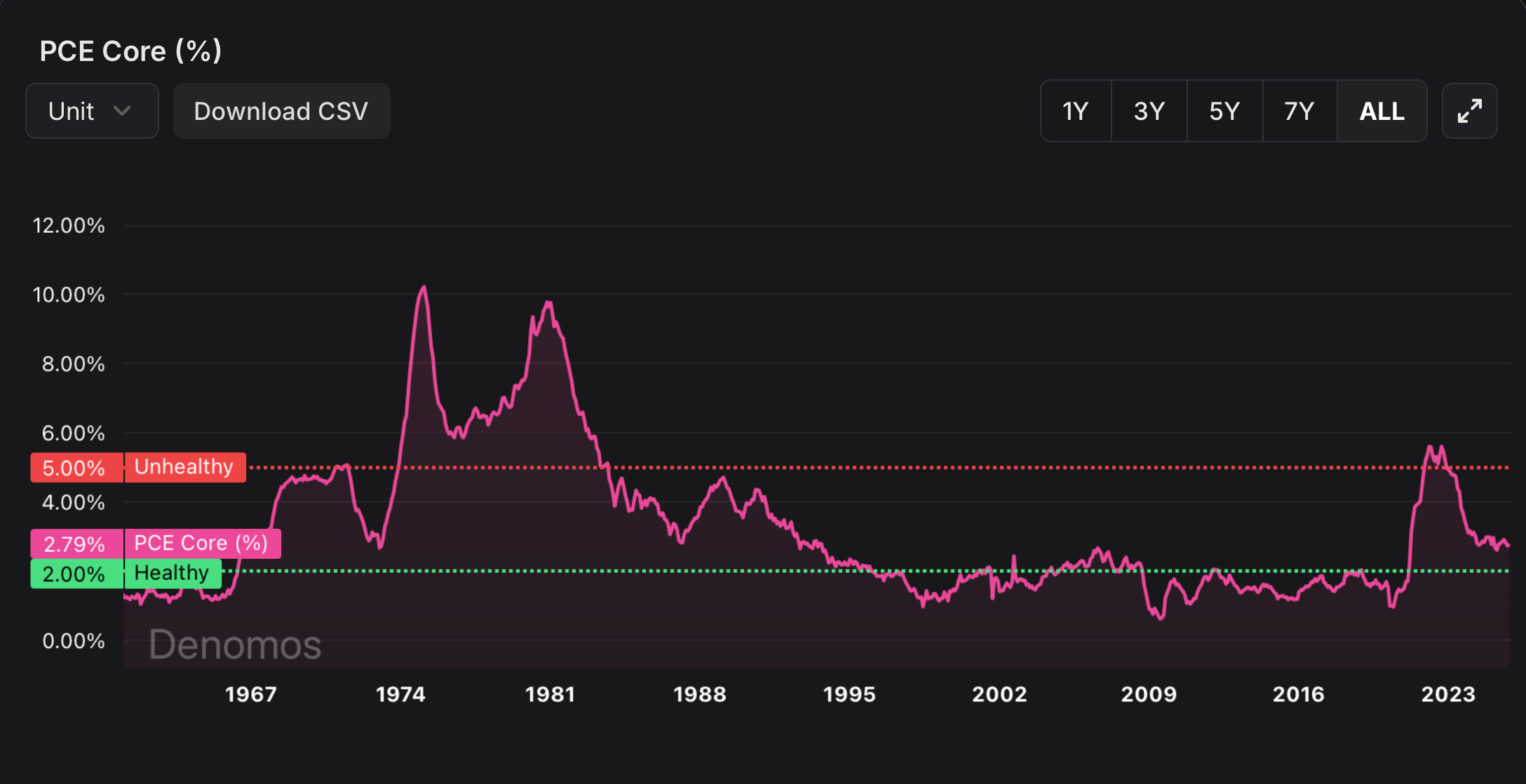
Today, we received the latest PCE and core PCE data for December 2025. On the surface, the numbers do not look dramatic. Headline PCE came in at 2.9% YoY, while core PCE printed 3% YoY, slightly below the 3.1% expectation.
But for crypto investors, the key question is not whether the number “beat” or “missed.” The real question is what regime these numbers keep us in.
If markets were hoping for a clear path toward easier monetary conditions and a renewed risk-on environment, this release does not fully support that narrative. Inflation is not accelerating aggressively, but it is not falling toward the target either.
📬 In this issue:
The latest PCE data and why it matters for crypto investors
Other market signals that still point to relatively tight conditions
What this means for your portfolio positioning
Before we dive in, one small favor: if you find this analysis useful, consider hitting the ❤️ button or sharing the post. It helps this newsletter reach other retail investors trying to navigate the same environment.
As a fellow retail investor glued to these releases and Denomos data dashboards, I would describe this as movement, but not a regime shift. Let’s break it down.
The Latest PCE Data and Why It Matters for Crypto Investors
Core PCE is one of the primary indicators the Federal Reserve uses when assessing inflation dynamics and deciding whether to tighten or ease financial conditions. Unlike CPI, which measures a relatively fixed basket of goods, PCE adjusts more dynamically to changes in consumer behavior.
A simple way to think about it: CPI asks, “How expensive is the same basket?” PCE asks, “What are consumers actually buying, and how are those prices evolving?” Because of that flexibility, the Fed places greater emphasis on PCE, especially the core version, which excludes food and energy.
For December 2025, core PCE printed at 3% YoY, with a 0.2% increase compared to November. While slightly below expectations, it remains meaningfully above the Fed’s approximate 2% target. That matters.
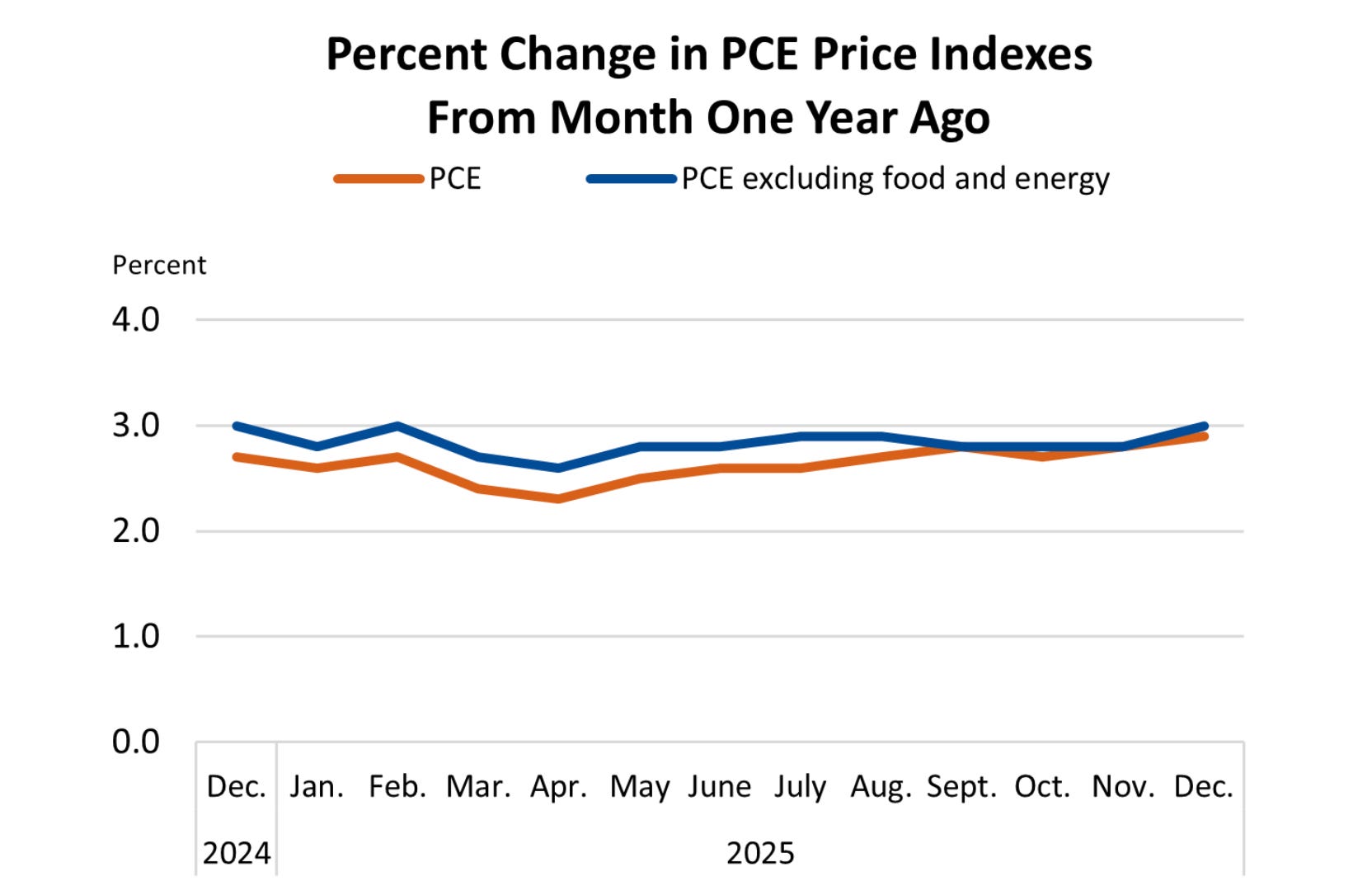
This level of inflation does not support the case for imminent rate cuts. If anything, it keeps the Fed cautious.
Now, let’s look at the real interest rate (RIR). With the latest inflation reading, RIR declined from 0.85% to 0.65%. In general, lower real rates tend to support risk-on assets, including crypto and especially altcoins.
However, the source of the decline and timing matter. If real rates fall because nominal rates are being reduced, that usually reflects monetary easing and expanding liquidity. In this case, real rates declined because already elevated inflation increased further, rather than because nominal rates were reduced. That is a less constructive setup.
When real rates decline due to strong inflation pressure, the Fed has less flexibility. Liquidity does not automatically improve. In that configuration, crypto does not receive a clean macro tailwind.
Beyond the Core PCE: Other Market Signals Showing Tight Conditions
No single indicator should drive portfolio decisions. In any cycle, one metric can temporarily mislead. A regime assessment becomes more reliable when multiple signals align.
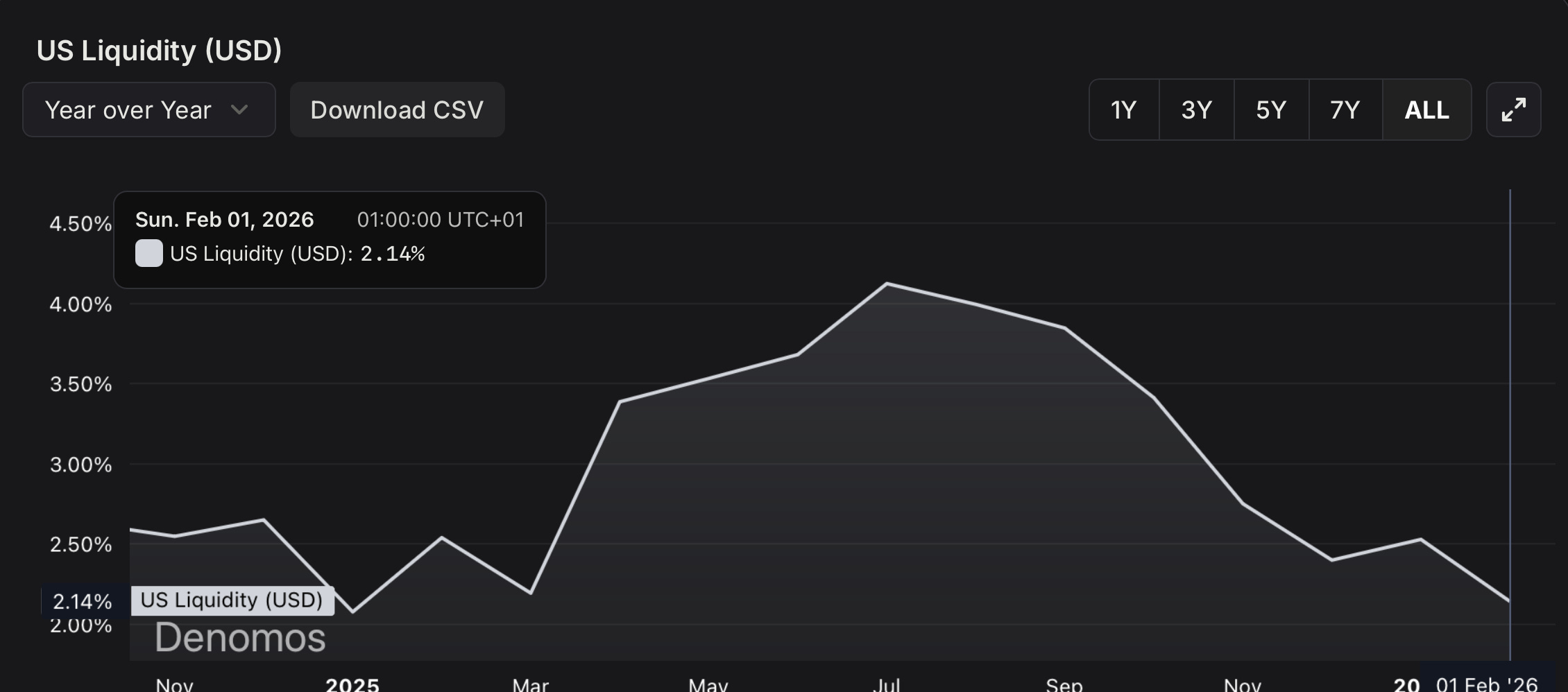
Liquidity Growth. The Denomos Global Liquidity Index (GLI) shows stagnation in February compared to January. Year-over-year growth stands at 9.9%, which is positive in isolation. However, U.S. liquidity increased by only about $50B month-over-month and is growing just 2.14% YoY. That is modest. Liquidity is not contracting, but it is not accelerating in a way that would typically ignite a broad altcoin expansion.
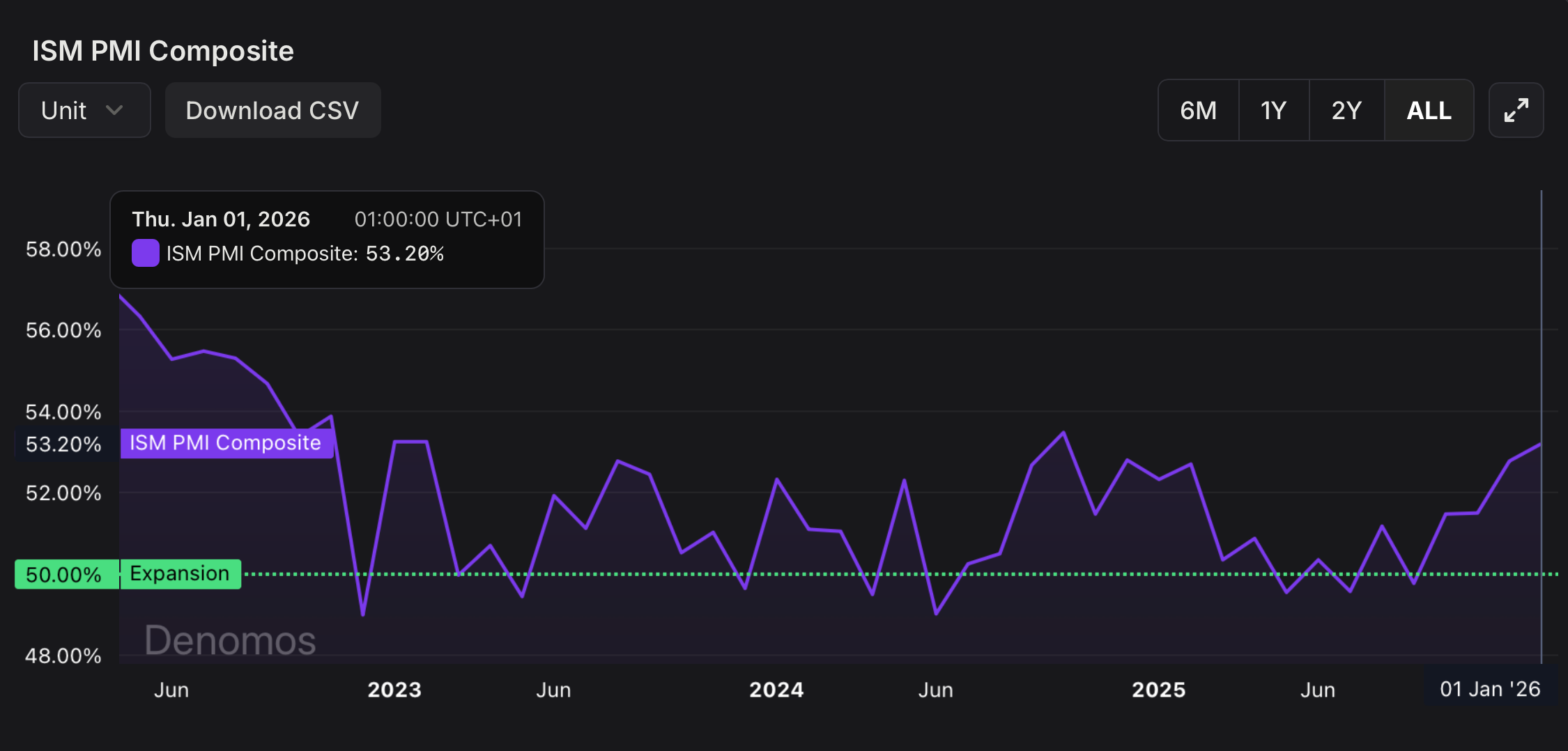
ISM PMI Composite. Our Denomos composite, weighted 70% services and 30% manufacturing, has risen 3.4% over the last four months to 53.2%. That signals stabilization and mild expansion. Still, it remains within the same broad range observed since late 2022. This is improvement and not acceleration.
USD Trend. The dollar is consolidating between 95 and 100 within a broader downtrend. Structurally, a weaker dollar tends to support crypto. But consolidation implies a pause rather than momentum. For now, this signal is slightly constructive but not decisive.
Gold Trend. Even after a sharp correction, gold remains in an uptrend. Persistent strength in gold usually reflects defensive positioning. It does not typically coincide with aggressive risk-on behavior in speculative assets.
TIPS Yield. Real yields around 1.8%, combined with high nominal yields and relatively sticky inflation, suggest financial conditions remain restrictive. For a more favorable altcoin environment, we would need to see real yields move sustainably lower, ideally into negative territory. We are not there yet.
Taken together, these signals lean toward continued tight conditions rather than a clear shift to risk-on.
What This Means to Your Portfolio
When we combine PCE data with liquidity trends, PMI stabilization, dollar consolidation, gold strength, and elevated TIPS yields, the broader picture remains closer to risk-off than risk-on.
This does not imply that crypto cannot rally in the short term. Markets can move ahead of macro improvements. But from a regime perspective, conditions for a full-scale altcoin season are not yet aligned.
Altcoin seasons are often treated as inevitable phases. In practice, they are conditional.
Given the current regime, my approach remains conservative. I am personally 100% allocated to BTC at this stage, for reasons I’ve outlined in my previous posts and notes. That said, I also believe tokenized gold can be a reasonable complementary allocation in this type of macro environment.
Optimism is reasonable, though aggressiveness may be premature.
Closing Words
I am a retail investor, just like you, and a co-founder of Denomos, an analytics platform built for crypto retail investors. The data discussed here, including the GLI and composite indicators, is available on Denomos to help you recognize different market regimes more objectively.
If you want weekly analytical posts designed to assess when conditions favor altcoins and when caution is warranted, consider subscribing to this Substack. The goal is not to chase narratives but to align with regimes.
Thank you for reading. I am not a financial advisor. This is simply my interpretation of the data. Always do your own research and manage risk accordingly. 🙏
See you in the next one! 🍻