
As a retail investor, my first encounter with DeFi was anything but simple. I had to learn how MetaMask works, understand the differences between protocols, constantly check whether something was a legitimate smart contract or a potential scam, and, just as stressful and no less demanding, make sure I knew where and how my seed phrases were stored. Today, those steps feel relatively straightforward to me, but at the time, it was a true on-chain baptism by fire.
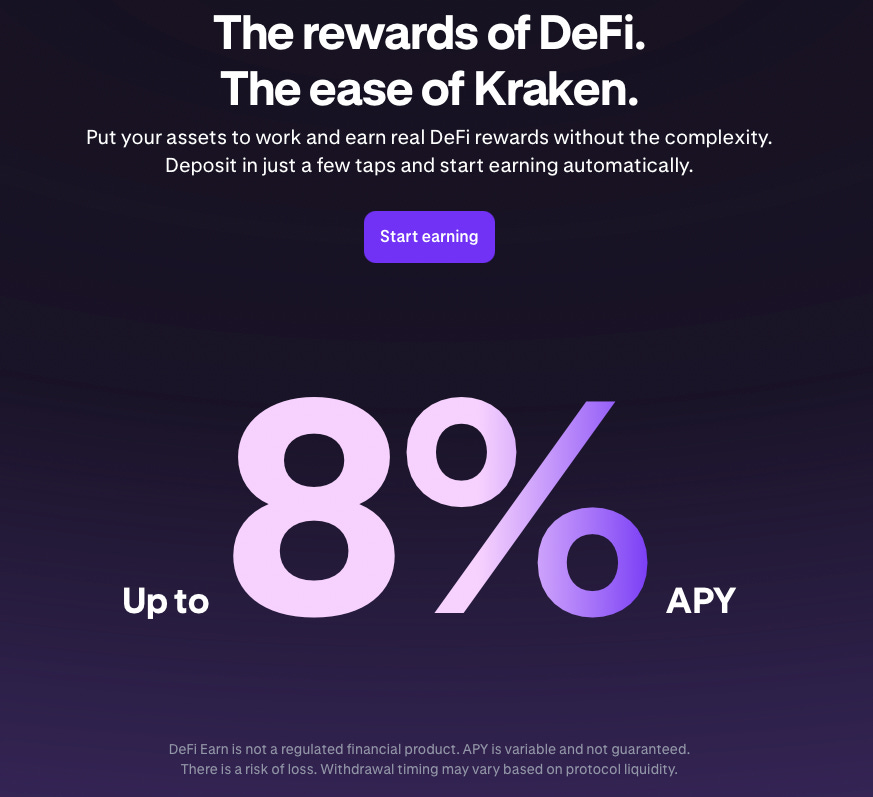
That is precisely why the news caught my attention that Kraken launched DeFi Earn on January 26, 2026; a product that enables access to DeFi yields directly through a centralized exchange. No wallets, no manual interaction with protocols, and no need for users to make technical decisions that carry operational risk. In its current form, DeFi Earn offers up to approximately 8% APY on stablecoins, and, importantly for context, it is available to users in the U.S., the EU, and Canada.
While at first glance this may look like just another yield product among many similar offerings, in a broader regime context it represents a meaningful shift: an attempt to combine CEX-level simplicity with DeFi infrastructure at a time when retail investors, facing a challenging market environment, are once again thinking about sources of passive income, but with a far greater focus on risk than during the previous cycle.
In this post, I explain how Kraken’s DeFi Earn actually works, why it may be relevant for a specific profile of retail investors, and how it differs from similar solutions offered by other exchanges such as OKX or Binance.
What Is Kraken DeFi Earn and How Does It Work?
Kraken is one of the oldest and most relevant centralized crypto exchanges globally, with a strong focus on regulated markets such as the U.S., the EU, and Canada. For that reason, it is often perceived as a gateway for retail investors seeking crypto exposure while maintaining higher standards of security and regulatory compliance.
Kraken DeFi Earn is an attempt to make DeFi yields accessible without the usual on-chain barriers. The mechanism is as follows: users deposit fiat or stablecoins, the funds are converted into USDC, and then deployed into managed vaults operated by Veda Labs, one of the larger infrastructure providers for DeFi vault solutions. These vaults are implemented on Ink Chain, Kraken’s Layer 2 network. The yield itself is generated through established DeFi protocols such as Aave, Morpho, and Sky, with options across Balanced, High, and Advanced vaults, offering yields of up to approximately 8% APY.
It is important to clarify what is meant by managed vaults and the role of Veda Labs. A vault in this context is not a passive pool of funds, but a structured on-chain strategy that aggregates user capital and automatically allocates it across predefined DeFi protocols according to preset risk parameters. Veda Labs acts as an infrastructure layer: it designs, maintains, and operates these strategies, but does not make discretionary, ad-hoc decisions like a traditional fund manager. Investor capital is deployed into established lending protocols such as Aave or Morpho, where it is used for overcollateralized lending, with continuous monitoring of key parameters such as utilization rates, collateral quality, and liquidation thresholds. Risk management is further automated through real-time AI risk monitoring tools (Chaos Labs, Sentora), which can adjust exposure or signal the need for more defensive positioning if market conditions deteriorate. In other words, investor capital is not locked into a single protocol or exposed to a single point of failure, but becomes part of a dynamically managed DeFi strategy, aimed at generating stable returns while limiting operational and systemic risk, without requiring retail users to make technical on-chain decisions themselves.
An important detail for retail users is that there are no traditional lock-up periods, withdrawals are relatively fast, and Kraken charges a 25% fee only on earned rewards, not on principal. In practice, this means that today, through a CEX like Kraken, users can access DeFi technology (on-chain lending and yield strategies), without worrying about wallets, gas fees, or safeguarding seed phrases.
For example, if you deposit $1,000 in USDC, at an 8% annual yield you could expect approximately $80 per year, with significantly lower operational risk than direct DeFi usage. Naturally, it is important to expect that this yield will likely decline over time as more capital flows into the same strategies and as market conditions change. Even in that scenario, however, such yields are likely to remain more attractive than what the average retail investor can obtain in TradFifor a comparable risk and liquidity profile.
Why Is This a Big Step for Retail Investors?
For many retail investors, DeFi was never unattractive because of yields, but because of uncertainty. Hacks such as Ronin or Poly Network, smart contract vulnerabilities, and complex interfaces pushed many participants to remain on the sidelines. Kraken DeFi Earn directly targets this issue: yield is generated from proven protocols, while the user experience remains within a regulated CEX environment.
The key advantage here lies in the combination of regulatory structure, operational simplicity, and controlled risk. Retail investors do not need to think about which chain to use, how to select the right pool, or how to assess protocol-level technical risk, those layers are abstracted away. Of course, risks do not disappear entirely: temporary withdrawal delays may occur due to vault liquidity constraints or extreme market conditions. Still, compared to direct on-chain interactions, this represents a significantly “softer” entry point into DeFi.
In the broader context of 2026, this product fits into a clear trend: CEXs are increasingly integrating DeFi in order to attract mainstream users. This is a signal that the technology is maturing and moving beyond its niche origins toward the broader financial ecosystem.
Comparison With Other CEXs – Who Offers Something Similar and How Is It Different?
Kraken is not the only exchange attempting to bridge CeFi and DeFi, but it differs in execution. It emphasizes a no-friction approach: on-chain yield with AI-based risk monitoring, delivered through a simple app interface.
OKX is arguably the closest competitor, offering a hybrid model via its Web3 wallet and Earn section, with direct access to lending protocols and liquidity pools. Stablecoin yields on OKX (USDT/USDC) can range from 2% to 10% APY, depending on promotions or fixed-term options, but require greater user involvement and active wallet management. Fees are generally low, with no mandatory lock-ups for flexible options, but the experience is less automated than Kraken’s.
Binance offers a broad suite through Binance Earn and its Web3 wallet. Stablecoin yields typically range from 3% to 8% APY for USDC, supported by deep liquidity, but the structure is more CeFi-oriented, with less transparency around on-chain mechanics and no explicit yield fees beyond general limits. The Web3 wallet requires more steps than Kraken’s “one-click” approach, though flexible options allow instant redemption.
Bybit provides Earn products focused on staking and USDC yield, including options like Mantle Vault for USDT/USDC (flexible, lower risk). Specific APYs are not always disclosed, though historical ranges have been around 3–15% in similar products. It lacks the same level of AI risk tooling as Kraken and is better suited to users already comfortable with derivatives and higher-risk environments.
Crypto.com offers yields that have historically reached 5–10% with bonuses, but primarily through centralized lending models and often with lock-up periods (e.g., three months for better rates), reducing flexibility. Direct DeFi integrations like Aave are limited.
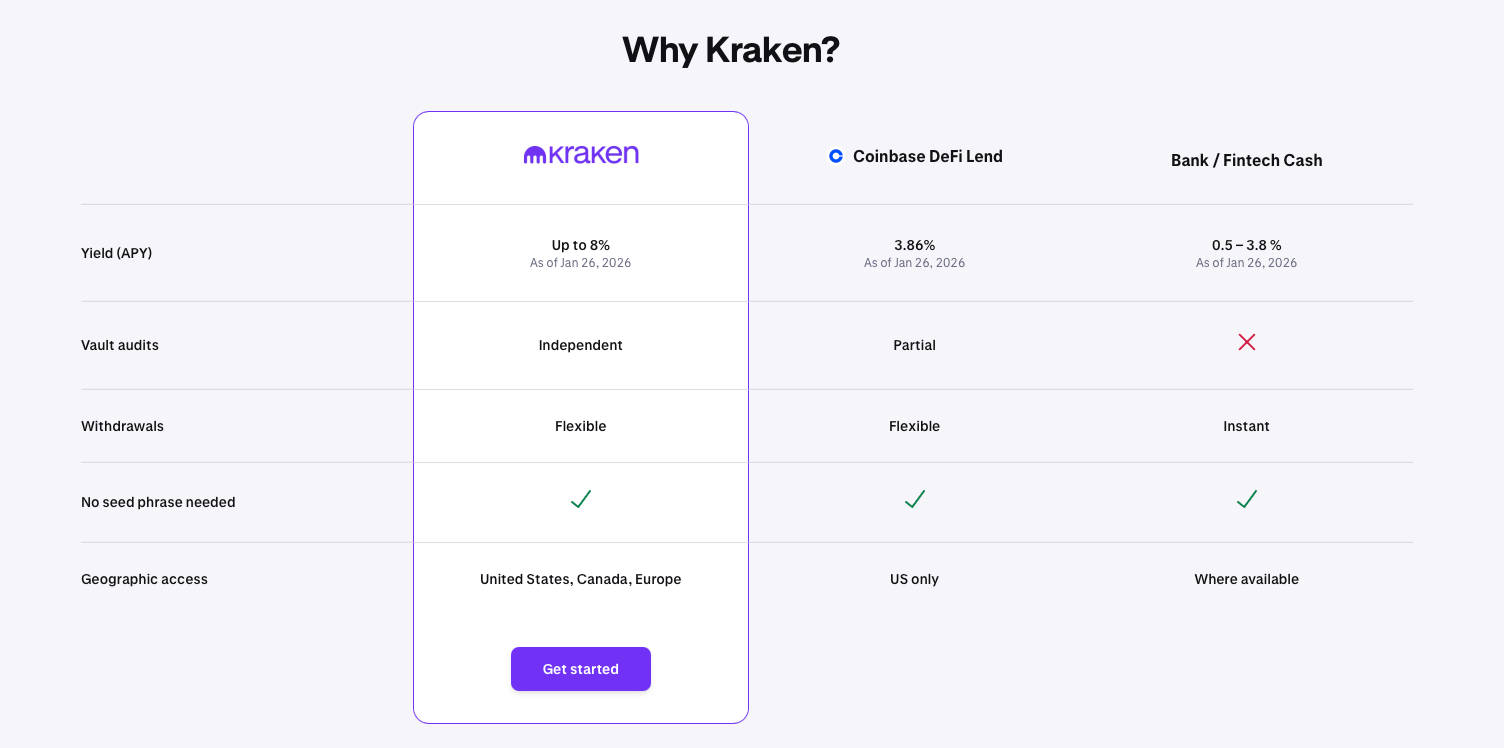
Coinbase, while technologically advanced via Base L2, does offer stablecoin yield products: up to 3.50% APY on USDC holdings with membership, or up to 10% via Morpho lending on Base, with no lock-up but potential withdrawal delays. It focuses less on educational rewards and more on direct on-chain integrations, making it closer to Kraken in terms of simplicity.
Overall, Kraken stands out for its no-friction design: everything happens within a single application, without additional wallet setup, with relatively transparent yield sources and a strong emphasis on risk. OKX and Binance offer greater flexibility for advanced users, but for retail investors in regulated markets, Kraken DeFi Earn appears to be a more conservative and accessible option.
Closing Words
Kraken DeFi Earn is a good example of how 2026 is increasingly shaping a new phase of the crypto market: one in which retail investors can access DeFi benefits without DeFi chaos, directly through regulated CEX platforms. Instead of choosing between higher yields and operational risk, hybrid solutions are emerging that offer a reasonable trade-off on-chain yield, combined with the simplicity, infrastructure, and protection most retail users are accustomed to. This does not mean DeFi is “solved” or risk-free, but that it is becoming more accessible and better aligned with a broader investor base.
I’m curious to hear your view: would you rather use DeFi services through a CEX like Kraken, for simplicity and lower operational risk, or do you still prefer self-custody wallets and direct on-chain access, with greater control but higher risk? Share your thoughts in the comments - I always find it valuable to hear how other retail investors think about these trade-offs.
If you found this post useful, consider subscribing. I publish weekly and monthly analyses for crypto retail investors, focusing on whether the current market regime favors risk-on altcoins or more defensive, lower-volatility options such as Bitcoin or tokenized gold.
And if you try Kraken DeFi Earn, let me know how it goes.
As always, a final reminder: this is not financial advice. Do your own research and invest only what you can afford to lose.
Cheers! 🍻