
Hello everyone.
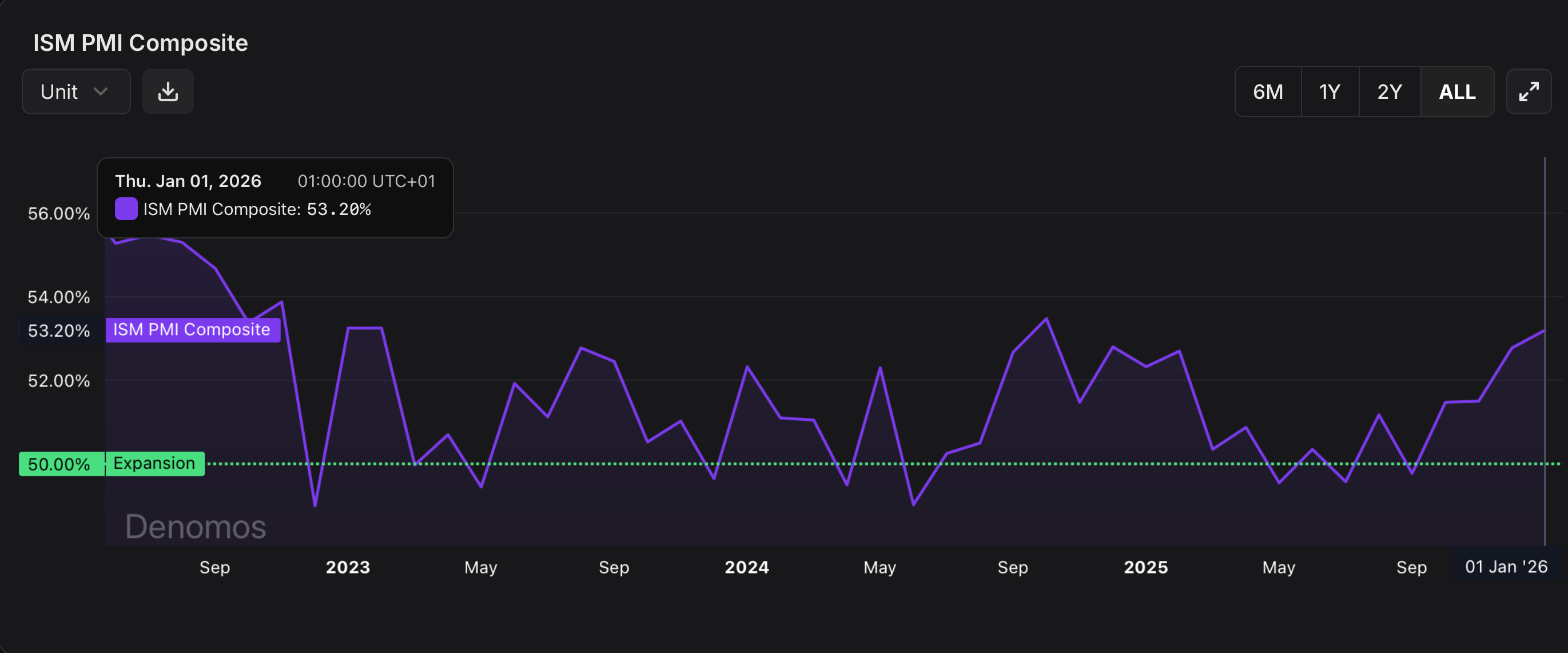
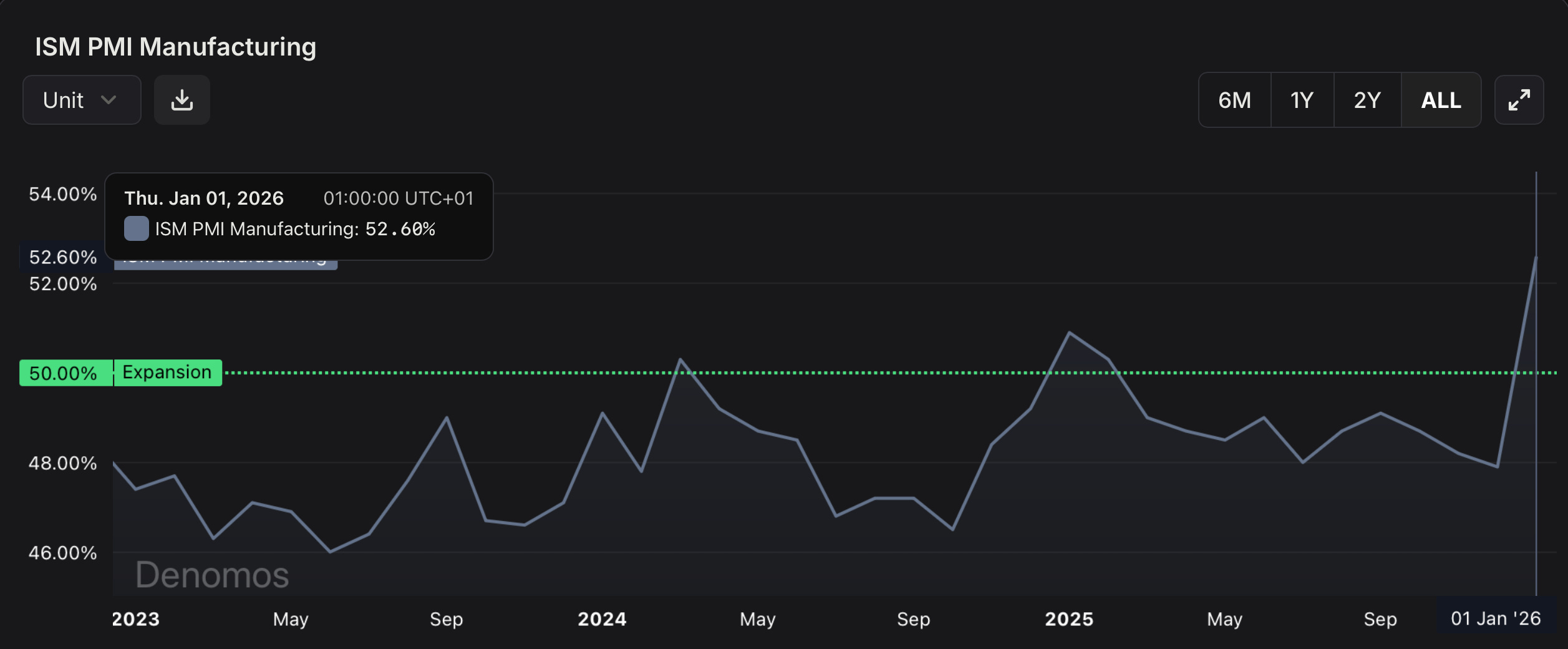
This week, I’m diving into a topic that macro investors see as indispensable and one that’s extremely important for crypto investors too. The January ISM PMI Manufacturing came in at 52.6%, up 4.7% month-over-month and at its highest level since August 2022. Non-Manufacturing stands at 53.8%, slightly down 0.6% from December. Our Denomos ISM PMI Composite, which combines both, is now 53.2, higher than last month and 3.4% above its level four months ago.
Manufacturing is clearly accelerating. That matters for risk assets, including crypto.
But does this automatically mean we are in a Risk-On regime?
In this issue:
The latest ISM PMI data and why it matters for crypto investors
Beyond PMI: Other market signals
What this means for your portfolio
Before we dive in, one small favor: If you find this analysis useful, consider hitting the ❤️ button or sharing the post. It helps this newsletter reach other retail investors trying to navigate the same cycle.
As a fellow retail investor glued to these releases and Denomos dashboards, this feels like a constructive shift. Let’s look at the full picture.
The Latest ISM PMI Data and Why It’s Important for Crypto Investors
PMI matters because it gives us a forward-looking signal about where we are in the business cycle. Above 50 indicates expansion. The trend and velocity often matter more than the absolute number.
Manufacturing at 52.6%, with a strong month-over-month acceleration, is significant. It has broken above levels not seen in three and a half years. Historically, when Manufacturing PMI re-enters expansion territory with momentum, it signals improving economic activity and rising risk appetite.
Non-Manufacturing at 53.8% remains in expansion but is losing some momentum. The divergence is interesting. Goods production is accelerating, while services are stabilizing.
Our ISM PMI Composite at 53.2 provides a broader view. Relying on only Manufacturing or only Services can distort the picture, especially in late-cycle or transition regimes. A composite smooths sector noise and gives a more balanced read of overall activity. The fact that it is up 0.4% month-over-month and significantly higher than four months ago suggests the macro backdrop is improving, not deteriorating.
From a crypto perspective, Manufacturing PMI moving into expansion with strength places the market in a zone where explosive upside becomes possible. Not guaranteed. Possible. Historically, strong cyclical acceleration has coincided with stronger performance in high-beta assets.
If we looked only at PMI, we would lean toward early Risk-On conditions. But no single indicator defines a regime.
Beyond the PMI
One indicator can mislead. Any single data point can be distorted by temporary effects or measurement issues. Regime identification improves when multiple parameters align.
Liquidity Growth: Global Liquidity Index growth in February was just over $150B versus January. US liquidity rose by only about $50B month-over-month. For crypto, which tends to track US liquidity most closely, this is weak. Expansive liquidity typically fuels sustained Risk-On moves. This is not that.
USD Trend: The dollar has been consolidating between 95 and 100 for almost a year within a broader downtrend. There is no clear breakdown yet. That keeps the signal neutral, slightly leaning Risk-On but without confirmation.
Real Interest Rate: Around 0.65%. Positive real rates are generally restrictive for altcoin seasons. With Core PCE near 3%, it is also difficult to see real rates healthily moving into negative territory. That limits the ideal backdrop for aggressive crypto expansion.
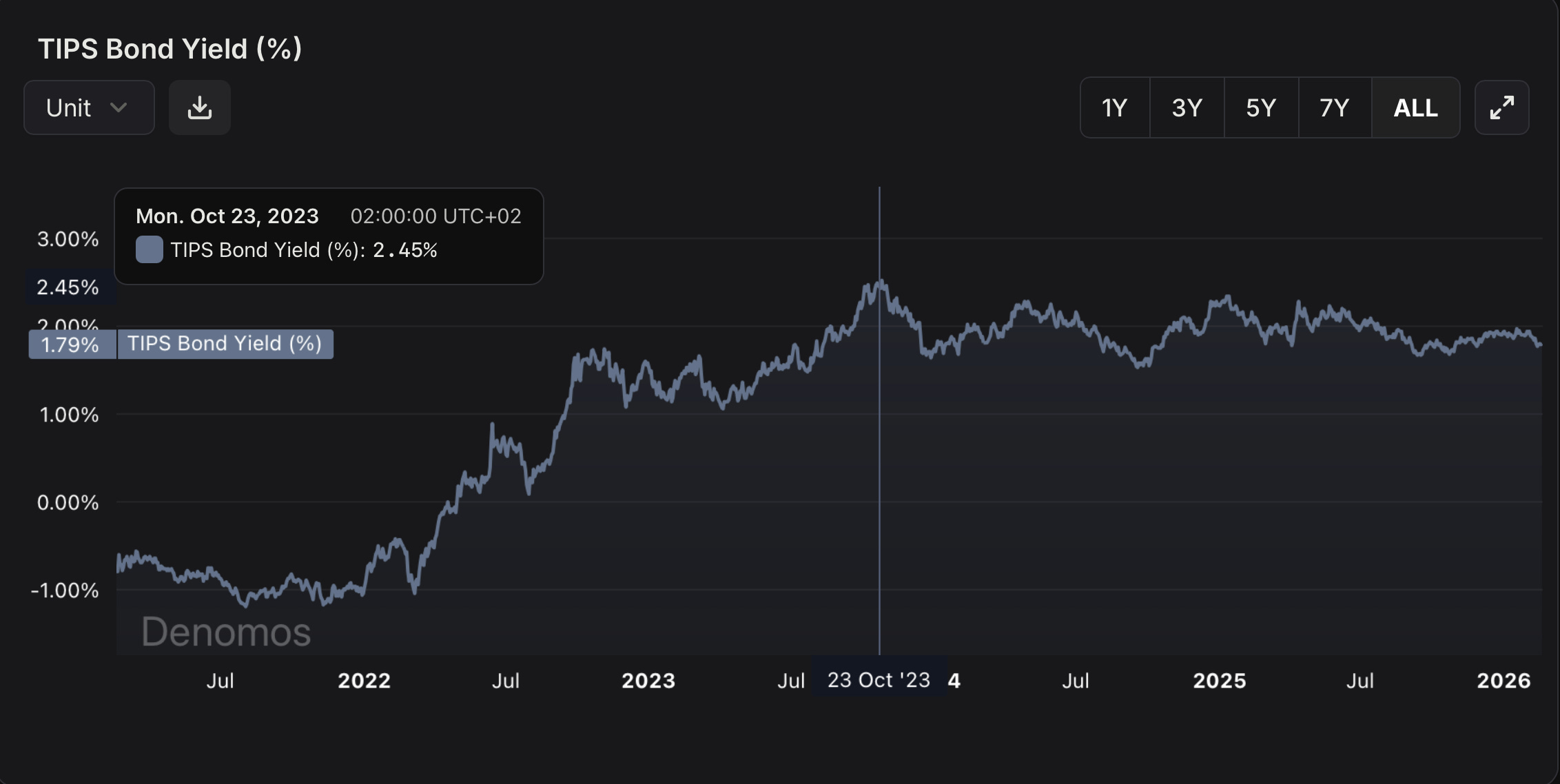
TIPS Yield: Near 1.8%. Positive and rewarding bond holders. When real yields are attractive, capital allocation often favors fixed income over speculative assets.
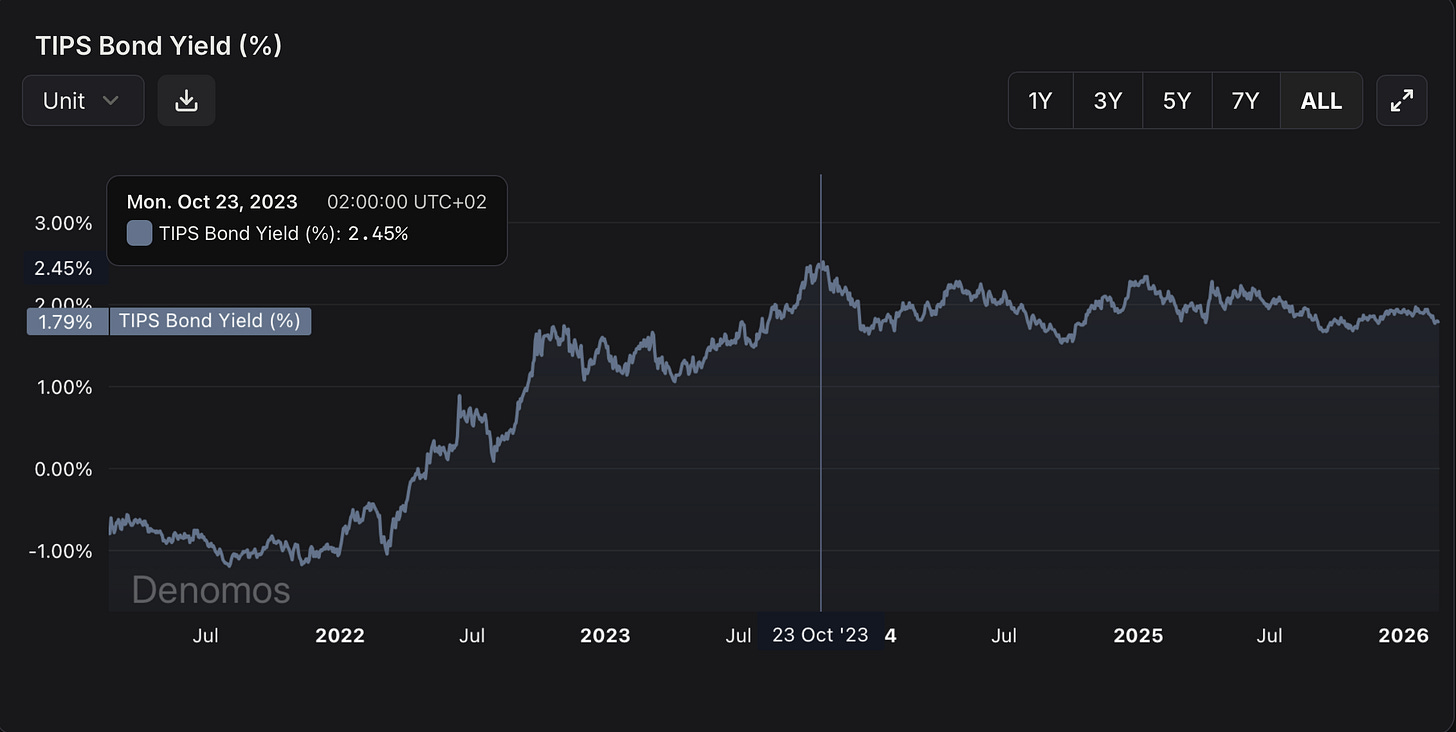
TIPS yields peaked above 2% in late 2023 and have eased slightly since, but remain near 1.8%. Real yields are still clearly positive, which continues to favor bonds over high-risk assets such as altcoins. Gold Trend: Rising. That typically reflects defensive positioning, not broad Risk-On enthusiasm.
Oil Trend: Also rising. Part of this may reflect improved activity, but geopolitical tensions, including potential US-Iran escalation, are contributing. Rising energy costs can tighten financial conditions rather than ease them.
Put together, liquidity and rates are not aligned with a clean Risk-On regime. PMI is constructive. The rest of the matrix is mixed to cautious.
What This Means for Your Portfolio
When we step back, most parameters do not yet support a full altcoin season.
Manufacturing PMI is strong. That is a necessary condition for broader risk expansion. But it is not sufficient on its own. Liquidity growth remains modest. Real yields are positive. Defensive assets like gold are rising.
In this environment, positioning in relatively stronger crypto assets may be more rational than rotating aggressively into high-beta altcoins. Bitcoin, tokenized gold, or even stablecoins can serve as transitional positioning depending on risk tolerance.
Personally, I am currently 100% in BTC. That is not advice. It reflects my reading of the current regime.
The market has been under pressure for years. From these levels, upside potential is structurally larger than downside over the long term. The question is timing, not direction.
Closing Words
I’m a retail investor just like you, and co-founder of Denomos, an analytics platform built to help crypto investors recognize market regimes. All the data discussed here, including our PMI Composite, is available there for deeper analysis.
If you want weekly analytical breakdowns to help decide when to lean into altcoins and when to stay defensive, consider subscribing to this Substack.
I’m also curious: why do you think PMI Services is stagnating while Manufacturing accelerates? Is AI efficiency a factor, or something else?
Thanks for reading. I’m not a financial advisor. This is simply my interpretation of the data. Always do your own research and manage risk carefully.