

👋 Welcome back.
After a relatively calm previous week, the new ISM PMI report has once again reopened a familiar question: is the business cycle beginning to “heat up” slowly, and if so, does that actually mean we are moving closer to conditions that could be more favorable for altcoins, or is it still too early to draw that conclusion?
The goal of this weekly note is one thing only: to assess, based on data and regime context, whether the market currently favors altcoins or Bitcoin.
📬 In this issue:ISM PMI: what it says about the business cycle
Global Liquidity Index (GLI): structure, trend, and implications
Federal Reserve policy, rates, and forward guidance
Dollar strength (DXY) and its impact on crypto assets
Indicator synthesis and market regime assessment
Risk-On Environment Score (by Denomos)
Altcoins vs Bitcoin: regime-driven allocation
My portfolio positioning and key decision triggers
Before we move into the data, a small request: if you find this analysis useful, consider clicking the ❤️ button or sharing the post. It helps me reach other investors who are trying to make sense of the same questions I am.
Without dragging this out further, let’s get to the point.
Is The Business Cycle Heating Up?
The business cycle is one of the key pillars in determining the macro regime, as it directly affects capital availability, risk appetite, and investor selectivity. When business activity accelerates, financial conditions usually become more supportive, and the market has a greater capacity to “absorb” riskier assets; when activity stagnates or slows, capital naturally migrates toward more liquid and stable positions.
Within this framework, I use PMI as the central indicator of the business cycle. More specifically, I rely on the ISM PMI Composite (calculated by Denomos), which combines the manufacturing and services sectors and therefore better reflects the structure of the U.S. economy. For a more detailed explanation of how and why I interpret PMI in the context of digital assets, see this previous post.
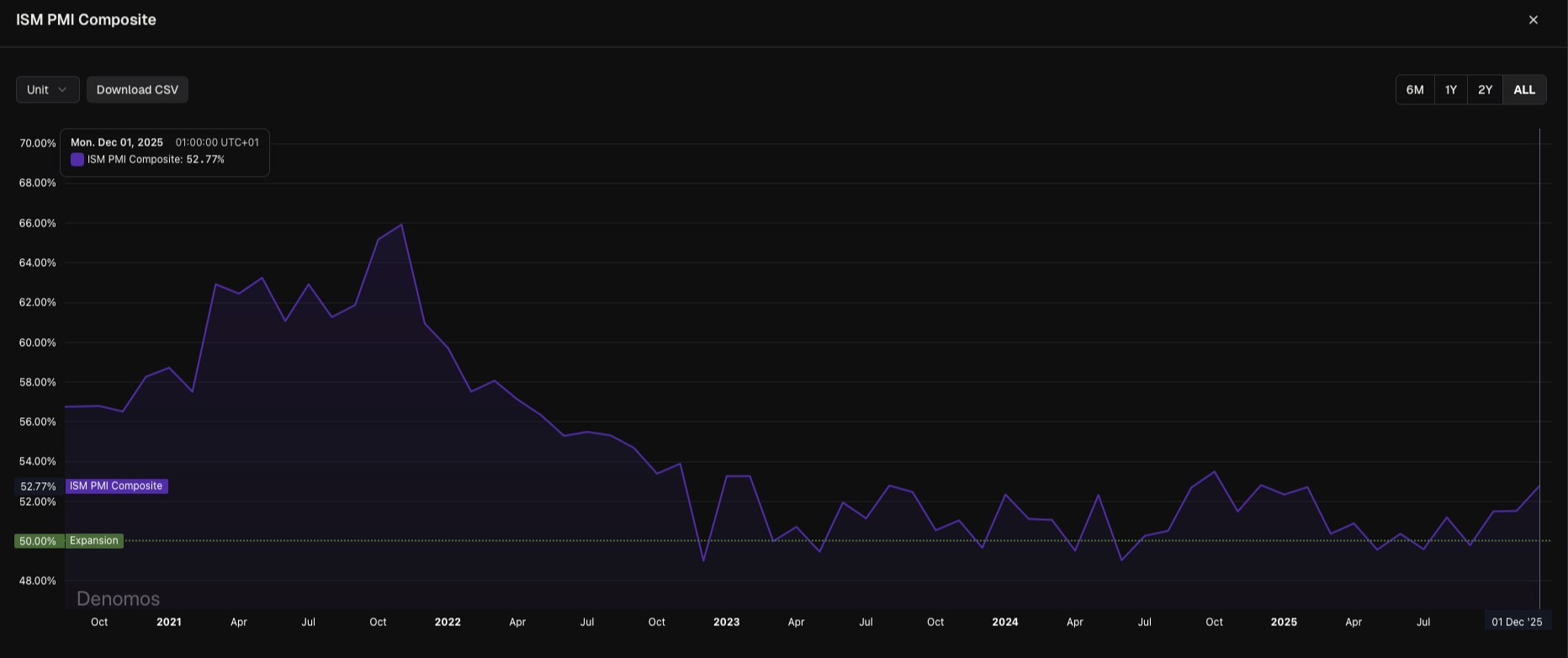
The current PMI reading stands at 52.78, up from 51.5 last month, which is an encouraging move and can be interpreted as mild “heating” of the cycle. However, it is important to keep the broader context in mind: PMI has remained within a wide range of roughly 49 to 53.5 since December 2022, and historically, such movement, without a clear breakout and acceleration, has not been sufficient to label the regime as risk-on, nor to suggest conditions that are ideal for a genuine altcoin season.
Global Liquidity is Stagnating
Global liquidity represents the broader backdrop within which capital availability moves across the financial system, and it is one of the most important regime signals for digital assets. When liquidity expands rapidly and broadly, markets have the capacity to take on more risk; when liquidity stagnates or grows slowly, selectivity increases. In this context, I use the Global Liquidity Index (GLI) as an operational measure of that process. I have previously explained in more detail what I mean by global liquidity and how I interpret GLI here.
More specifically, I rely on the GLI built on the Denomos platform, as it is not trivial to reconstruct or easily available on other platforms, and it is explicitly designed for regime analysis rather than short-term signals.
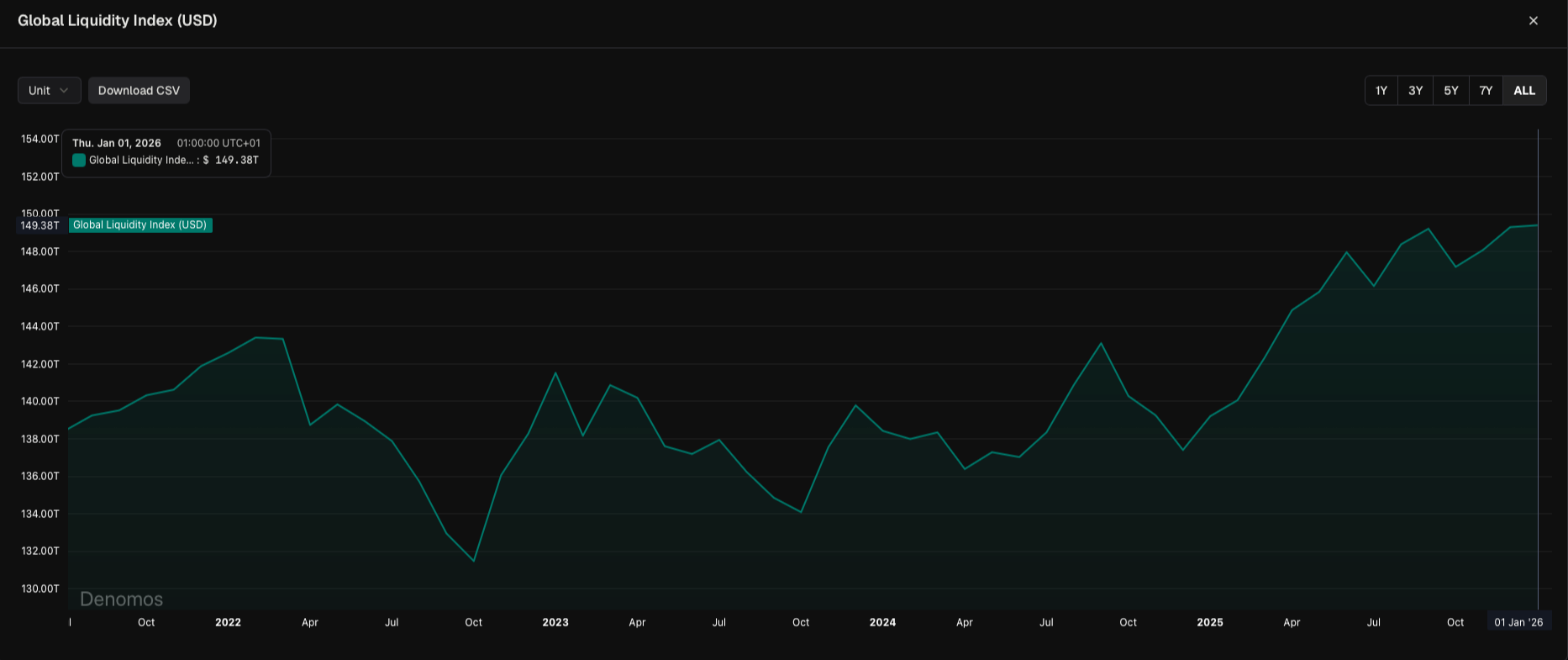
The current state of global liquidity does not appear particularly stimulative. The cumulative GLI level is around $149.38T, slightly below last week’s ~$150T and only about $3.5T higher than six months ago. At the same time, year-over-year (YoY) growth over the past six months has fluctuated between roughly 5% and 8%, pointing to a slow and non-accelerating liquidity expansion.
In such an environment, while there is no acute tightening, conditions remain relatively restrictive and historically insufficient for a broad and sustainable altcoin season.
US Monetary Policy Unchanged: Waiting for Late January
U.S. monetary policy remains one of the most important inputs in my framework, because Federal Reserve decisions are the channel through which the most direct impact on global financial conditions and risk asset markets occurs.
The Federal Funds Rate remains around 3.64%, while the real interest rate is approximately 0.81%. Those levels historically do not support aggressive risk-taking. At the same time, the Fed’s balance sheet stands at roughly $6.64T, only marginally above the five-year low reached in November 2025 ($6.55T), while neither the Treasury General Account (TGA) nor the Overnight Reverse Repo (ON RRP) facility shows any meaningful shifts. In short, monetary conditions are effectively unchanged from last week.
In this environment, relatively restrictive conditions continue to favor risk-off assets, and within the Bitcoin versus altcoins dilemma, that balance clearly tilts in favor of Bitcoin.
As for forward-looking projections, according to the Summary of Economic Projections (SEP) released on December 10, 2025, following the FOMC meeting, the Federal Reserve expects inflation to remain under control over the next 6–12 months, with unemployment potentially drifting slightly lower. That said, geopolitical risks and potential trade tensions remain a source of uncertainty.
The next FOMC meeting is scheduled for late January, and only after that will we have a clearer picture of whether the monetary regime is genuinely approaching a shift or remains in this transitional state that is still unfavorable for altcoins.
DXY Consolidating Within a Broader Downtrend
I view the U.S. Dollar Index (DXY) as an important regime filter, because a strong dollar has historically not been compatible with a sustained altcoin season. When the dollar strengthens, global financial conditions tend to tighten, liquidity becomes more expensive, and appetite for riskier assets declines; in such an environment, capital struggles to remain allocated to smaller and more volatile digital assets.
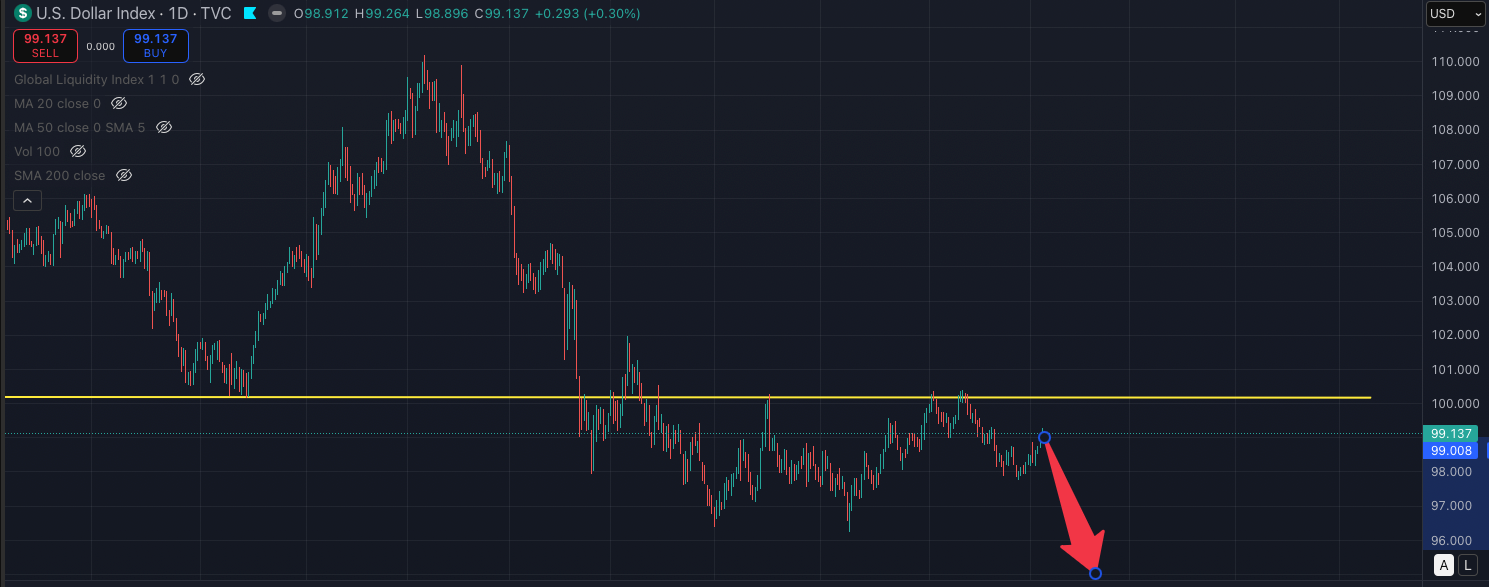
Currently, DXY has been moving for several months within a relatively narrow range between approximately 97.5 and 100, after breaking a key support level around 100, all within a broader downtrend that has been in place since January 2025.
That broader downtrend is, in itself, a positive signal for risk assets and potentially for altcoins as well. However, it is important to note that the dollar is not in a “free fall” at this point. Instead, we are seeing a consolidation phase and a pause in the move.
Even so, I consider it more likely that the downtrend will continue in the coming months, partly because the U.S. government has a clear incentive to tolerate a weaker dollar to more easily service interest payments on public debt, which currently stands at approximately $36.2T.
A continuation of this downtrend would be a constructive signal and an additional tailwind for conditions that, alongside other indicators, could become more favorable for an altcoin season.
Indicator Synthesis
When we combine all of the above readings into a single picture, the regime conclusion remains relatively consistent:
The business cycle is showing mild improvement, but still without the acceleration that has historically been sufficient for a clear risk-on transition;
Global liquidity is stagnating and expanding too slowly to support broad speculative expansion;
U.S. monetary policy remains restrictive in relative terms, with positive real interest rates and no meaningful balance sheet expansion.
The only indicator currently leaning toward a risk-on interpretation is the dollar trend, which remains in a broader downtrend but is still moving through a consolidation phase.
Because of this asymmetry, where most key variables continue to signal caution, while only one element points toward a gradual easing of conditions, I conclude that the market remains predominantly in a risk-off regime.
In such an environment, between Bitcoin and altcoins, the regime-driven choice for me remains Bitcoin.
Risk-On Score Supports This Synthesis
The Risk-On Score is an index we developed specifically to serve as a synthesis layer and a consistency check for regime analysis. The goal is not to replace it, but to assess whether individual conclusions still make sense when all key indicators are considered together.
The current value of the score stands at approx. 60 and has remained largely flat for quite some time, without clear acceleration or a regime shift. Historical behavior in previous cycles shows that such levels have not been sufficient to trigger a sustained altcoin season; broad and synchronized altcoin outperformance has typically emerged only once the score moved above the 80 threshold and remained there.
In that context, the current Risk-On Score further confirms the conclusion that the market remains in a transitional, but predominantly risk-off environment.
Closing Words
All indicators and parameters used in this newsletter are part of the analytical framework we are building within the Denomos platform, where I am a co-founder.
This framework includes a simplified but robust Global Liquidity Index, constructed from central bank balance sheets, M2 money supply, the Treasury General Account, RRP, and liquidity dynamics across the world’s twenty leading economies. It is updated weekly and tracks both cumulative levels and YoY changes to better capture liquidity momentum. Our GLI is less complex than institutional solutions, but significantly more accessible and more informative than generic indicators.
In addition, we track ISM PMI data (services and manufacturing), combined into a composite index with weightings that more accurately reflect the structure of the U.S. economy, alongside YoY dynamics that capture changes in business conditions over time.
All key Federal Reserve monetary policy data (interest rates, balance sheet metrics, and forward guidance) are also available in one place, with notifications when new data is released. Beyond that, we monitor broader monetary trends, capital flows, and potential signs of stress within the crypto market.
All of these inputs are synthesized into the Risk-On Score, designed to signal when market conditions structurally shift toward or away from risk-taking, with alerts when key thresholds are crossed.
Thank you for reading. If you would like to be notified when the next analysis is published, consider subscribing (for free) to my profile. 🍻