
Iran’s closure of the Strait of Hormuz has now been met with a response from the US. From today, the passage is effectively restricted for vessels moving to and from Iran, with the goal of increasing economic pressure through limiting oil exports.
The immediate question is not just geopolitical but also economic. This type of disruption introduces a risk that extends far beyond the region, primarily through energy markets. If the situation persists, the probability of a broader financial crisis increases due to both rising oil prices and reduced availability of key resources.
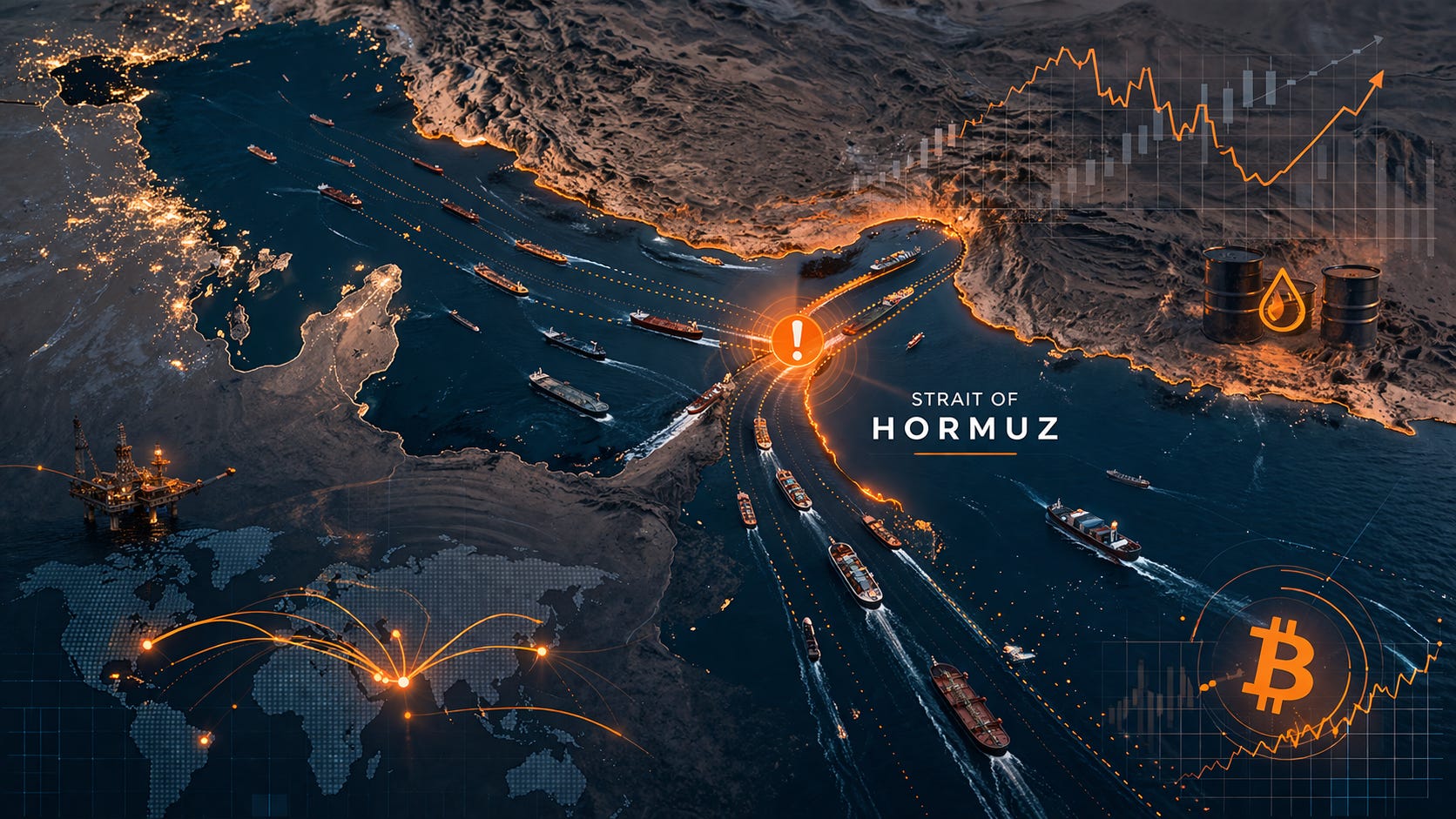
For crypto, this is not a neutral development. The environment created by supply shocks tends to affect liquidity, which remains a core driver for the broader market.
This post breaks down what is happening, why it matters, and how it may impact altcoins under current conditions.
A Critical Chokepoint for Global Resources
Before going further, a brief overview is useful. This is not a deep technical breakdown, but enough context to understand why this situation matters.
The Strait of Hormuz is the most important oil chokepoint globally. Roughly 20% of total global oil consumption flows through it. A significant portion of that comes from Saudi Arabia, accounting for more than one third of that volume, while Iranian oil represents a bit over 10%. Most of this oil is directed toward Asian markets, while Europe and the US rely more on alternative routes.
The impact extends beyond oil. Qatar, for example, produces around one third of the world’s helium as a byproduct of LNG processing. Disruptions here affect semiconductor production and AI-related infrastructure, where helium is critical for cooling systems. This creates indirect pressure on the technology sector.
Fertilizers are another channel. Between 20% and 30% of global maritime fertilizer transport passes through Hormuz. Disruptions here affect agricultural output in regions such as India, Brazil, China, the US, and Europe. This introduces upward pressure on food prices.
Petrochemicals follow a similar pattern. The Gulf exports over 40% of global polyethylene and large volumes of other chemical inputs. Reduced supply leads to higher costs across packaging, textiles, automotive, and electronics production.
Most developed economies maintain strategic reserves that can cover roughly three to four months of oil demand. Less developed countries typically hold significantly lower reserves, making them more sensitive to immediate disruptions.
According to the consensus of economists and analysts in 2026, oil prices above $120–130 per barrel begin to create broader economic strain. Sustained levels in the $140–150 range increase the probability of a global recession, especially if maintained over several months.
When Inflation Comes Without Liquidity
Rising oil prices translate directly into higher costs across the economy. Transportation becomes more expensive, production costs increase, and consumer prices follow. This is supply-driven inflation.
In practical terms, incomes do not adjust at the same pace. If fuel, food, and essential goods become more expensive while wages remain relatively stable, purchasing power declines. That typically reduces discretionary spending and limits capital available for investment.
This creates a stagflationary tendency. Growth slows while inflation remains elevated.
For crypto, this type of environment is structurally challenging. The broader market depends on liquidity, which is more closely tied to demand-driven inflation. When inflation is driven by supply constraints, central banks tend to avoid easing. In many cases, they tighten policy further to prevent inflation from becoming embedded.
That response works against the conditions required for risk assets to perform. Without expanding liquidity, high-beta segments of crypto, particularly altcoins, tend to struggle. Most crypto assets still rely on liquidity expansion rather than organic cash flow, which makes them sensitive to this shift in regime.
Two Paths Depend on Energy and Policy
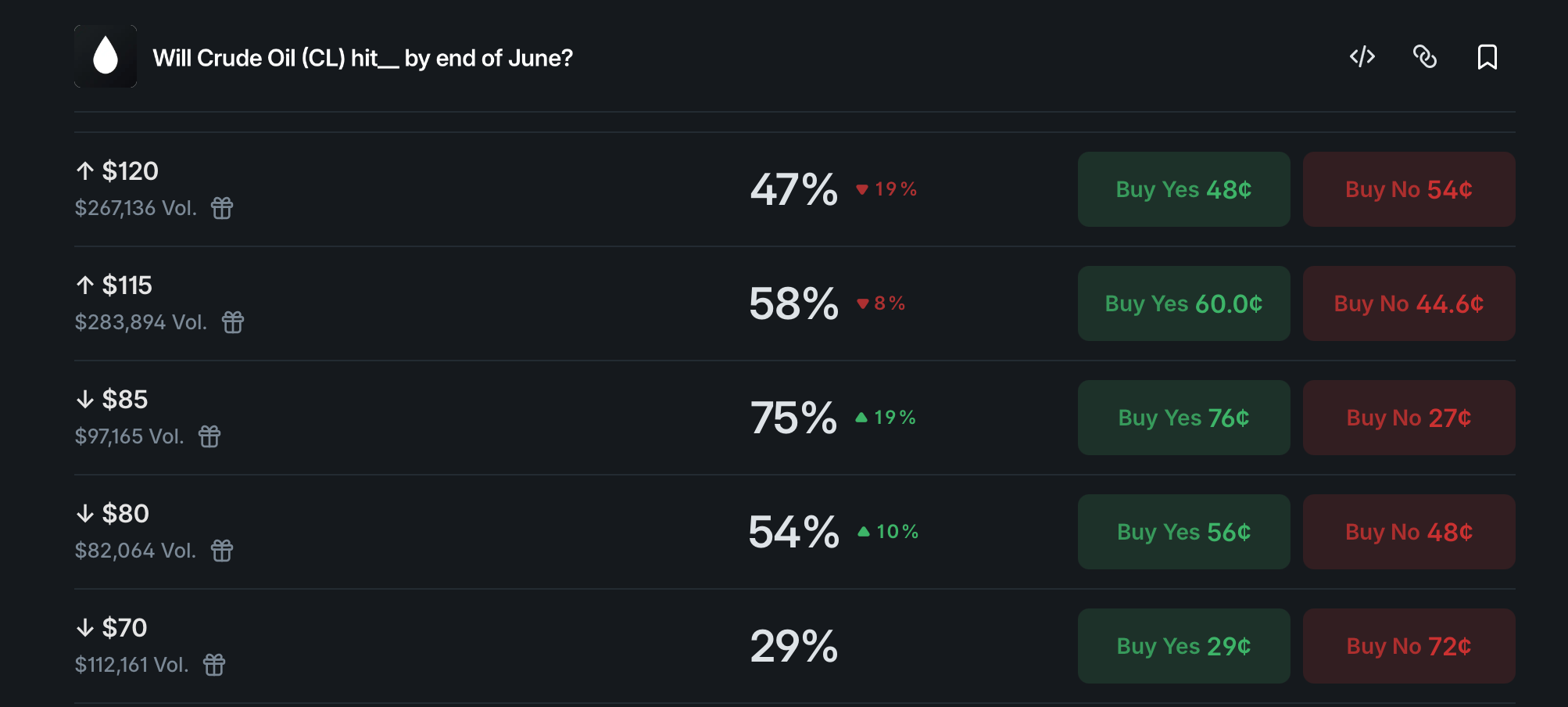
Current market expectations reflect uncertainty around how this situation resolves. On Polymarket, there is a 74% probability assigned to oil prices falling below $85 by the end of June. This suggests that many participants expect the conflict to stabilize or partially resolve.
However, there are a few possible outcomes.
In a negative scenario for crypto, supply-driven inflation persists. Oil remains elevated, inflation stays high, and central banks are forced to maintain or increase rates. This limits liquidity and creates pressure on high-beta assets. A more extreme version involves a financial crisis emerging before policy can adjust.
In a more constructive scenario, the conflict de-escalates. Oil prices normalize, inflation moves lower, and central banks regain flexibility. In that environment, liquidity can expand again, which tends to support risk assets, including altcoins.
At this stage, both paths remain possible. The difference lies in how long the disruption lasts and how quickly energy markets stabilize.
I will continue to track these developments and adjust my view as conditions evolve (subscribe for a weekly update!).
How I Am Positioned Right Now
My main portfolio remains 100% allocated to Bitcoin. This is not a short-term view based on price, but a reflection of how I see the current regime.
In an environment where inflation risk is rising, driven largely by supply shocks, and where central banks have limited room to ease, the conditions are not supportive for broad risk-taking. Liquidity is unlikely to expand in a meaningful way under these constraints, and that is a key requirement for most altcoins to perform.
Because of that, I see Bitcoin as a more resilient position relative to the rest of the market. It is still a risk asset, but in periods of uncertainty, capital tends to concentrate rather than disperse.
At the same time, I am actively considering reallocating part of the portfolio into gold. Gold has corrected recently, while the probability of a prolonged conflict remains elevated. I am currently monitoring the BTC/Gold ratio and looking for a move toward the 0.06 level before making that decision.
If the situation resolves faster than expected, that may create a better setup for altcoins. Until then, I prefer to stay conservative.
To be clear, some altcoins will outperform Bitcoin in this market environment. However, that outcome is currently more selective than broad, and it can be challenging to identify them consistently.
Closing Words
I write weekly about macro conditions and how they affect the crypto market.
The focus is on regimes. Liquidity, inflation, growth, and how those variables shape risk-on and risk-off environments.
I also share how I position my own portfolio based on those conditions.
If this type of analysis is useful to you, feel free to subscribe and follow along. 🍻
And as always, this is not financial advice.
See you soon.