

Global liquidity has become one of the most frequently discussed topics in the crypto retail space over the past few years, largely thanks to some of the most influential macro-oriented voices, such as Raoul Pal. Despite that popularity, however, the concept itself often remains superficially understood and reduced to simplified narratives.
This post is intended for crypto retail investors who want to take a step further in their financial education, not in terms of price forecasting, but in understanding how the global financial system actually works, how liquidity moves across different regimes, and what implications that has for the crypto market in 2026.
📬 In this issue:
(1) What global liquidity is and what it actually measures,
(2) What the Global Liquidity Index (GLI) is,
(3) How liquidity cycles have historically been reflected in the crypto market, and
(4) How to think about investment strategies across different phases of the liquidity cycle.
Before we get into the fundamentals, a small request: if you find this text useful, consider clicking the ❤️ button or sharing the post since it helps reach other investors who are trying to understand the same questions.
Let’s start from the beginning.
What Is Global Liquidity?
Global liquidity refers to the total amount of money and credit capacity available within the global financial system, including central banks, commercial banks, credit markets, and other sources of financing. At the time of writing (January 2025), global liquidity across the world’s 20 largest economies stands at approximately $151T, which provides a starting point for understanding the regime we are currently in, but not a guarantee of outcomes.
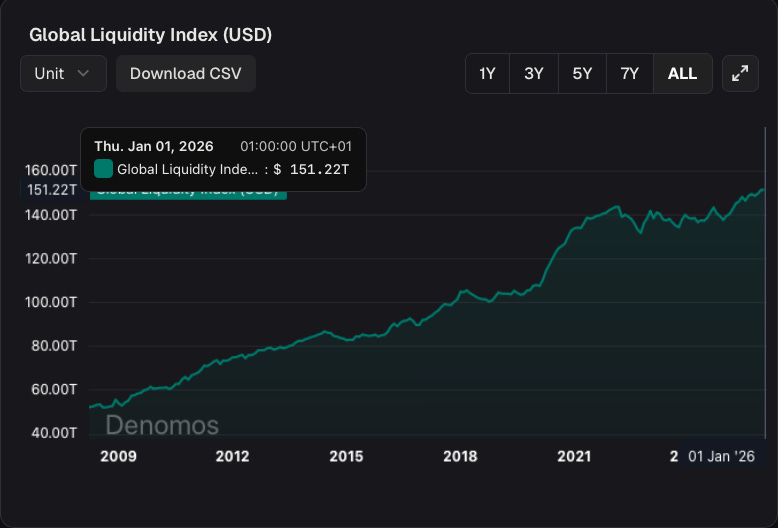
When global liquidity is abundant or expanding rapidly, financial conditions tend to loosen: access to capital becomes easier, financing costs decline, and risk appetite increases, which typically supports economic activity and rising prices of financial assets.
Conversely, when global liquidity is declining or stagnating, financial conditions tighten, credit becomes more expensive and less available, and economies and markets turn more selective and defensive. This is precisely why investors treat global liquidity as one of the key regime parameters: it does not tell us what will happen tomorrow, but it provides strong context on whether the system has the “fuel” for growth, or a tendency toward contraction.
In the context of crypto, global liquidity is particularly important because it has historically shown a strong correlation with bull and bear cycles. Periods of accelerating liquidity have often coincided with strong growth in crypto markets, while phases of contraction or stagnation have tended to be unfavorable, especially for riskier segments such as smaller altcoins.
What Is the “Global Liquidity Index” (GLI)?
The Global Liquidity Index (GLI) exists precisely because the concept of global liquidity is too broad and abstract to be observed through a single data point. The idea behind the GLI is to quantify global liquidity in a way that better reflects actual financial conditions in the system, rather than relying on partial measures such as local M2 aggregates or the balance sheet of a single central bank.
The concept of the GLI was originally developed by Michael J. Howell, founder and CEO of CrossBorder Capital, who has for many years published weekly estimates of global liquidity by aggregating data from approximately 80 of the world’s largest economies. In practice, the GLI is a composite metric that incorporates expansions and contractions of central bank balance sheets (including the Fed, ECB, BoJ, PBoC, and others), cross-border capital flows, credit conditions, financial stress indicators, and broader measures of global money supply.
The GLI provides a holistic view of liquidity that is significantly broader than local monetary indicators, and it functions as a leading indicator when assessing whether the global financial system is becoming more accommodative or more restrictive.
How GLI Signals Market Shifts: YoY vs. Cumulative
The GLI offers two important perspectives for observing regime changes: the year-over-year (YoY) growth rate and the cumulative trend.
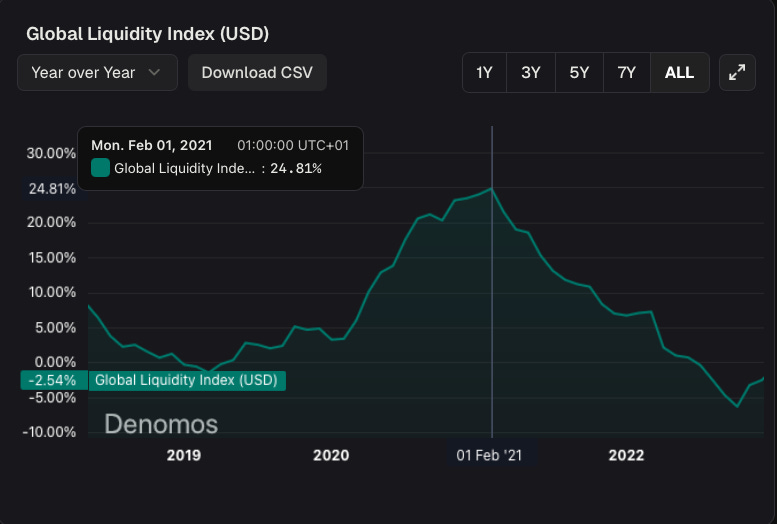
A decline in GLI YoY often signals the end of a bull market. For example, ahead of the 2022 bear market, GLI YoY peaked at approximately +25.5% on February 1, 2021, before entering a sustained decline. The peak in the altcoin market occurred later, when GLI YoY had already fallen to around +18.9%, confirming that markets often lag the peak rate of liquidity growth. By the time broader financial stress became visible in 2022, GLI YoY had already declined to roughly +6.9% and was in a clear downward trend.
Cumulative GLI, on the other hand, often lags, but it still has significant value for risk management. Before the 2008 crisis, cumulative GLI was still trending upward at the market peak in October 2007, but the first clear downtrend appeared in August 2008, when equities were already down approximately 20%, yet still far from the eventual decline of nearly 50%.
A similar pattern was observed in 2022: the first sustained decline in GLI Cumulative emerged in April 2022, when equities were down roughly 6%, before an additional decline of more than 20% followed. In that sense, GLI does not “catch the top,” but it can help avoid a large portion of the drawdown.
The Start of Bull Markets and Early Signals
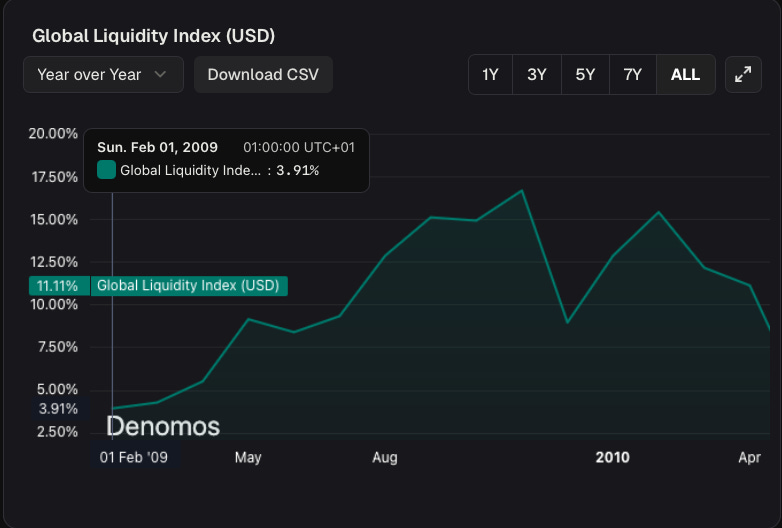
On the other side of the cycle, the return of liquidity growth often comes after the market bottom, but early enough to signal a regime shift. At the beginning of the 2009 stock market bull run, GLI Cumulative shifted back into an uptrend in April 2009, approximately 20 days after the absolute market bottom.
Similarly, during the post-2022 recovery, GLI Cumulative signaled a return to an uptrend in December 2022, after approximately eight months of decline, at a point when equities were already about 15% above their lows.
Here it is also important to understand the behavior of GLI YoY. At the start of the 2009 bull market, GLI YoY stood at approximately +10.4% and was clearly trending upward. In December 2022, by contrast, GLI YoY was initially negative (around –3%), but had begun to turn higher, which represented an early signal of a regime shift.
It is worth noting that conditions from 2022 to the present have not been ideal for a broad risk-on environment, but the transition of GLI YoY from negative to positive remains an important indication that the market is becoming more willing to take on risk.Liquidity Cycles and How They Affect the Crypto Market
Liquidity cycles represent recurring phases of expansion and contraction in the availability of capital within the financial system, and they exist as a natural consequence of borrowing and deleveraging, monetary policy, and changes in interest rates.
When global liquidity is rising, the availability of capital increases, financial stress declines, and historically the market’s willingness to take risk strengthens. In such regimes, smaller, more volatile, and higher-beta digital assets tend to outperform.
Conversely, when global liquidity is falling or stagnating, financial conditions tighten, opportunity costs rise, and speculative activity is suppressed; capital typically concentrates in assets perceived as safer or more liquid (for example, stablecoins or tokenized gold).
From this perspective, the liquidity cycle can most often be viewed through two primary phases: a tightening phase (Quantitative Tightening), during which central banks shrink balance sheets, raise interest rates, and withdraw liquidity from the system (historically an unfavorable environment for altcoins and speculative segments of crypto); and an easing phase (Quantitative Easing), in which financial conditions loosen, balance sheets expand, and liquidity re-enters the system, generally creating a more favorable backdrop for broader risk-on behavior in the crypto market.
Across these phases, the impact on crypto is not uniform: in tightening environments, Bitcoin tends to behave relatively better than altcoins, stablecoins often become a temporary “parking place” for capital, while in easing phases, altcoins have historically delivered disproportionately stronger performance, albeit with higher risk.
Professional investors do not monitor the GLI to predict short-term price movements, but to identify potential turning points in liquidity cycles. Changes in global liquidity rarely translate immediately into prices, but they very often precede shifts in market behavior.
This is precisely why the GLI is one of the key high-level indicators in my analytical framework for digital assets: it is not designed to time precise entries, but to provide context on whether the system is operating in a stimulative (risk-on) or restrictive (risk-off) regime.
Why Liquidity Is Never Sufficient on Its Own
Finally, it is important to emphasize that liquidity should never be viewed in isolation. The 2023–2025 period illustrates this clearly: despite rising global liquidity, the crypto market as a whole remained largely sideways, with only selective ATHs such as Bitcoin. The reason lies in the fact that financial conditions in the U.S. remained relatively tight, while other macro parameters failed to confirm a full risk-on regime.
Liquidity therefore provides a strong context, but decision-making requires synthesis with interest rates, monetary policy, the dollar, and the broader economic regime.
Closing Words
If you would like to continue reading analyses focused on the key parameters that shape market regimes, as well as to follow my investment journey across riskier and more defensive crypto positions, consider subscribing to my channel.
Moreover, if you are interested in tracking global liquidity, on the Denomos platform we have built a simplified but robust implementation of the Global Liquidity Index, designed primarily for regime analysis. This version of the GLI is constructed using aggregated liquidity dynamics from the 20 largest economies in the world, and includes central bank balance sheets, M2 money supplies, the U.S. Treasury General Account (TGA), and the U.S. Reverse Repo Facility (RRP). The index is updated weekly and monitored through both cumulative levels and year-over-year (YoY) changes, allowing for a clearer assessment of liquidity momentum and potential regime shifts.
While this implementation is less complex than institutional solutions such as those offered by CrossBorder Capital, it is more accessible and well-suited to digital asset analysis. Compared to generic proxy indicators or isolated metrics commonly used on other platforms, this framework provides a broader and more contextually meaningful view of global financial conditions.
Thank you for your attention. 🙏