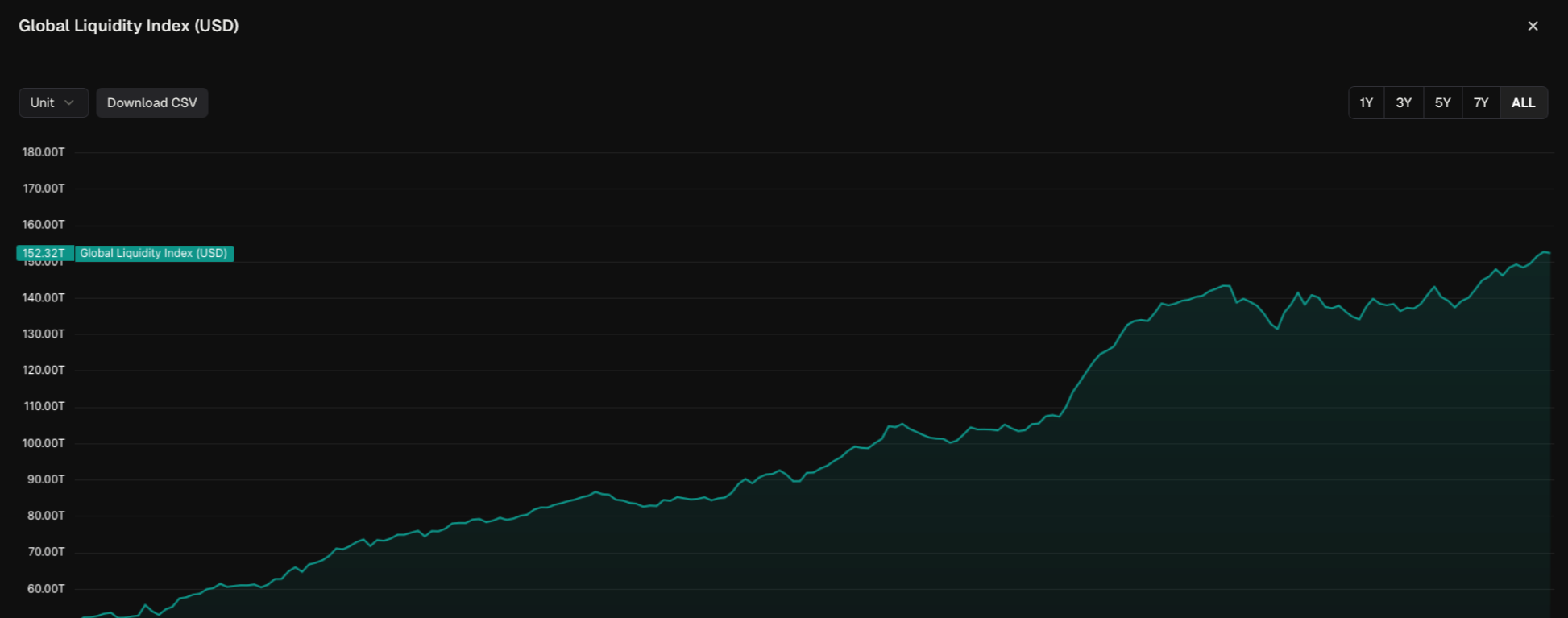
Fresh data just dropped: Global Liquidity Index (GLI) climbed to $152.66 trillion in January 2026, up $1.28 trillion from December’s $151.38 trillion. That’s a respectable monthly gain, and over the last three months we’ve seen $4.3 trillion in total growth. Year-over-year, GLI is now growing >10%, the first time we’ve seen that since October 2021.
For crypto retail investors, this liquidity pulse is one of the clearest signals we have: Is the market tilting risk-on (time to load up on high-beta altcoins) or risk-off (better to stay in Bitcoin and tokenized gold on-chain)?
My current read: conditions are still leaning risk-off, with liquidity growth that’s decent but not yet explosive enough to ignite the next altcoin season. That said, we are starting to see the very first positive flickers in months.
📬 In this issue:
Why GLI & global/US liquidity matter so much for crypto, and why the current numbers are supportive for BTC & tokenized gold, but still insufficient for altcoins
The other key macro signals (Fed, PMI, gold, Russell 2000, dollar, oil) and what the mixed picture is telling us right now
What this all means for your portfolio, and why I’m personally 100% in BTC & tokenized gold (no stablecoins) during this phase
Before we dive in, one small favor:
If you find this kind of macro + crypto analysis useful, consider hitting the button or sharing the post. 🙏
It really helps this newsletter reach more retail investors who (just like you and me) are trying to figure out when it’s safe to go risk-on in this wild market.
That’s it, thank you. Let’s get into the data.
Why Liquidity and GLI Matter for Crypto
Liquidity is the lifeblood of markets, especially crypto. Think of it like fuel in your car: Too little, and everything stalls; just enough, and you can cruise; a flood, and we’re off to the races with altcoins pumping. The Global Liquidity Index (GLI)tracks this “fuel” globally, pulling from central bank balance sheets, money supplies, and more across major economies.
January’s GLI hit $152.66T, a $1.28T month-over-month (MoM) increase from December’s $151.38T. That’s decent, but let’s zoom out: Over the last three months, GLI grew by $4.3T. Even better, year-over-year (YoY) growth topped 10% for the first time since October 2021, which is a milestone that historically juiced risk assets.
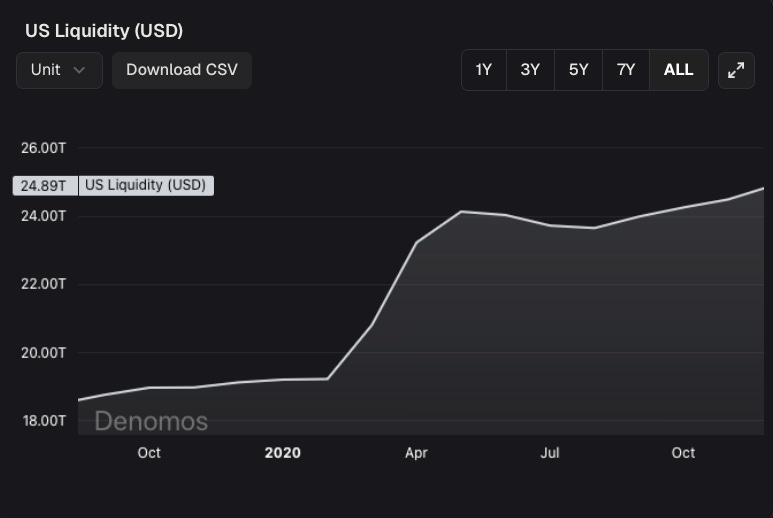
But here’s the catch: This isn’t explosive enough for an altcoin surge. US liquidity, which often leads crypto rallies, stalled at $28.13T in January, barely moving from three months ago. Remember the last altcoin boom? US liquidity skyrocketed 25% in just three months (February to May 2020) before things ignited. Right now, it’s flatlining, which is a red flag since the US drives much of crypto’s momentum.
We’re seeing growth in overall GLI, sure, but it’s more like a steady stream than a deluge. For risk-on assets, this feels insufficient; it supports stability in Bitcoin and tokenized gold (my go-to risk-off plays, ditching stablecoins entirely), but not the wild upside altcoins crave.
In crypto terms, low liquidity tightens conditions, making volatility king but favoring proven stores of value over speculative bets. We’ve seen this pattern before: Post-2021 GLI stagnation correlated with crypto winters, while YoY spikes above 10% often preceded rallies. This 10%+ YoY is promising, but without US leadership and bigger MoM gains, altcoins stay sidelined.
Beyond the GLI: Other Market Signals Showing Tight vs. Eased Conditions
While GLI sets the stage, it’s not the whole show. Let’s scan other key indicators for a fuller picture of market tightness or easing, since these often confirm further if we’re heading risk-off or risk-on:
FED Funds Rate and Real Interest Rate (RIR): At 3.64%, with a real interest rate at +0.85%, this advises caution. Positive real rates favor safe assets over riskier ones; historically, altcoin seasons kick off when RIR turns negative. Not good for starting an altcoin run yet (more about it here).
ISM PMI Index: Up to 53.2%, with 3.4% growth over the last three months → not bad, showing expansion. But it’s stuck in a range since November 2022 (nearly 3.5 years!), hovering around 50-55%. We’d need a breakout above 55%+ for real momentum; good, but insufficient for altcoins.
Gold Price and Trend: A sharp correction from $5,600 to $4,400 late January, but prices are rebounding with a clear uptrend intact. Gold’s strength signals risk aversion (investors fleeing to havens), which isn’t the vibe we want for altcoin pops.
Russell 2000 vs. S&P 500: Since August 2025, small-caps (Russell 2000) have outperformed the S&P 500 most of the time on a YoY basis. This rotation to riskier stocks is positive, suggesting broadening market participation. However, the outperformance isn’t as dramatic as in 2020-2021, so it’s a mild green light at best.
Oil Prices (WTI): Mild correction since December within a broader downtrend, so no reversal yet. Falling oil often eases inflation pressures, which could help liquidity, but we need a trend shift for stronger risk-on confirmation.
US Dollar: Spiked sharply from late January but remains in consolidation within a strong downtrend lasting over a year. A weakening dollar is bullish for crypto (cheaper for global buyers), but it lacks clear capitulation signs. Good, but not decisive.
These mixed signals confirm overall tight conditions, but the positives (like Russell and dollar) are the first real hints of warming up in months.
What This Means for Your Portfolio
Summing it up: The market leans more risk-off than risk-on right now, with GLI growth solid but not explosive, US liquidity stagnant, and most indicators showing tightness over easing. Positives like YoY GLI over 10%, small-cap outperformance, and dollar weakness suggest shifts could heat things up, potentially sparking crypto growth (especially altcoins) in the coming months.
For us retail investors, this points to sticking with safer blockchain assets like Bitcoin or tokenized gold for now. No rush into altcoins; watch for bigger liquidity surges or PMI breakouts.
p.s. I’m aware of the current turmoil in crypto (Bitcoin’s falling sharply amid volatility), but BTC has always bounced back in its 15+ year history. For me, it’s the ultimate safe haven; I’m 100% in without selling a thing. Hey, it’s not all doom; tiny macro changes could be the prelude to better times for altcoins and the whole crypto market (we see something stirring right now). Stay alert, but play it safe.
Closing Words
I’m a retail investor just like you, navigating this wild crypto space, and co-founder of Denomos, an analytics platform built for folks like us. All the data in this post (like our simplified but robust Global Liquidity Index (GLI)) is available on Denomos. It’s constructed from central bank balance sheets, M2 money supply, the Treasury General Account, RRP, and liquidity dynamics across the world’s 20 leading economies. Updated weekly, it tracks cumulative levels and YoY changes to capture momentum. Less complex than institutional tools like CrossBorder Capital, but way more accessible and informative than basic TradingView indicators.
If you want weekly analytical posts like this to figure out where to invest in crypto, whether altcoins or safer blockchain assets, subscribe to my Substack. It’s all about recognizing the right time in this industry.
Thanks for reading! Remember, I’m not a financial advisor. This is just my take based on the data. DYOR and invest wisely.
Cheers! 🍻