
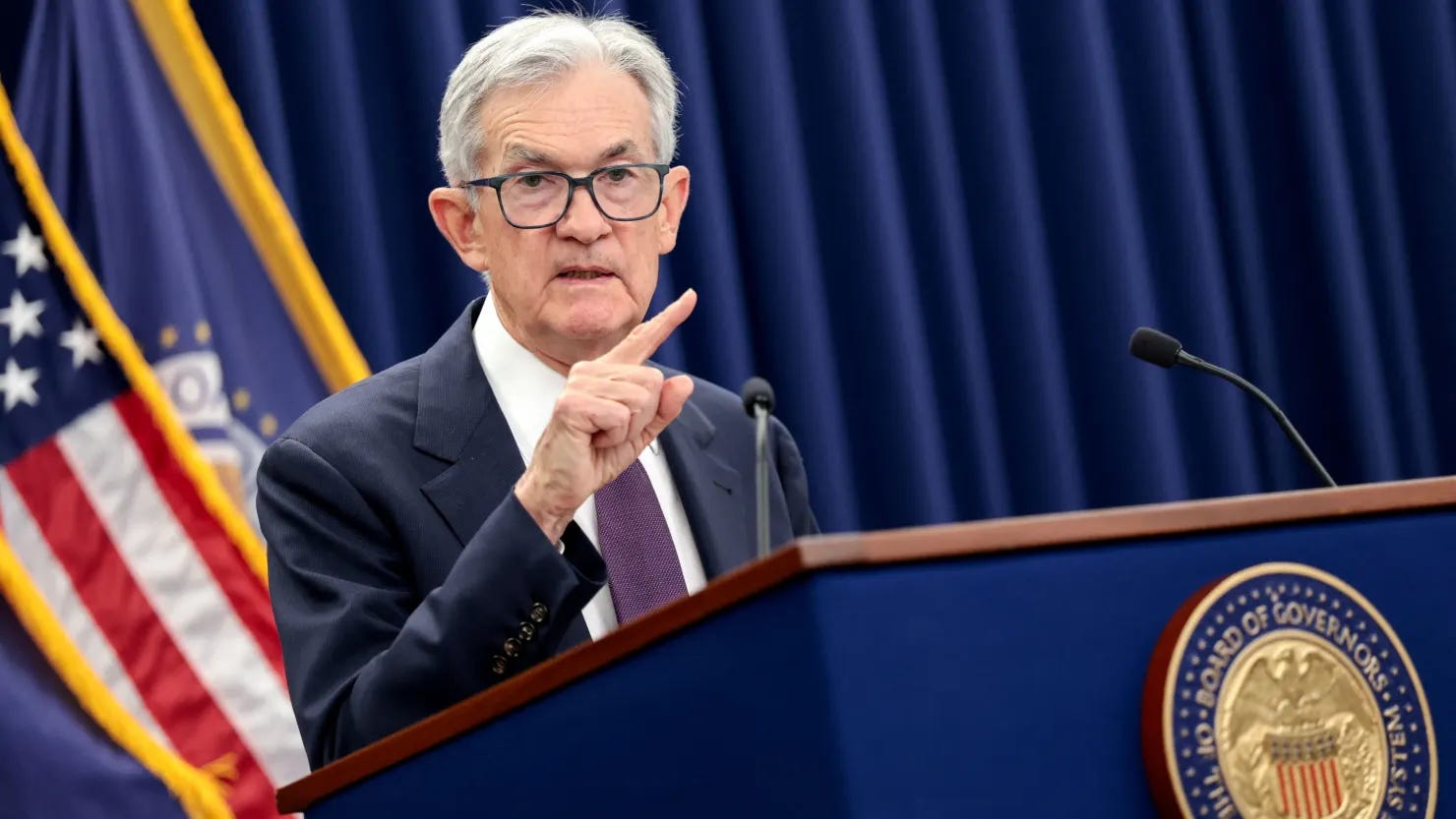
The Federal Reserve just held the federal funds rate steady at 3.5%–3.75% (decision from their January 28, 2026 meeting). No surprise, but it keeps the brakes on for now: no fresh cuts after the three we saw in 2025.
As retail crypto investors, this always raises the same question: Is it finally safe to go risk-on and load up on altcoins, or should we stay defensive in Bitcoin and tokenized gold on the blockchain?
Quick answer: This hold isn’t great news for high-risk plays like altcoins imo. Real interest rates remain positive (~+0.85%), which historically favors safe assets over speculative ones. We usually see the biggest crypto rallies when real rates turn negative and cheap money chases yield.
Inflation is still stubbornly above 2%, jobs are okay and not screaming for cuts, so the Fed stays patient. As a fellow retail investor tracking this daily (and pulling data from Denomos), I see caution winning right now, but a few early positive signals are starting to appear. Let’s break it down.
The Fed’s Decision and Why It Matters for Crypto
Real Rates: The Hidden Hurdle
Here’s why the Fed’s decision matters big time for crypto: Calculate the real interest rate by subtracting inflation from the fed funds rate. Using recent data (PCE core in the 2.6%-2.8% range for December 2025), the real rate sits positive, roughly +0.7% to +0.9%. Positive real rates act like a risk tax. They make safe, interest-bearing assets (like bonds or cash) more attractive than volatile ones. Historically, crypto (abd especially altcoins) thrives when real rates go negative. That’s when money gets “cheap” and flows into high-yield, speculative bets chasing returns.
Right now? No green light for that risk-on mode.
Inflation and Unemployment: The Sticking Points
The key problem is stubborn inflation. Headline CPI held at 2.7% year-over-year in December 2025 (latest full data). It’s been hovering in the 2.3–3% range for well over 18 months, refusing to sustainably drop below the Fed’s 2% target despite those prior high rates.
Unemployment? It’s at 4.4% (December 2025 data, with early January forecasts holding similar), up gradually since mid-2023 but stabilizing recently. Job gains are low but not crashing; the labor market is “resilient” per the Fed. This isn’t weak enough to force aggressive cuts; the Fed stays patient.
What It Means for Crypto
Fed policy isn’t favoring risk-on assets yet. We don’t know exactly when the shift to cuts resumes. It could even be months if inflation eases or jobs soften more. For my investment strategy, this means caution: Stick to safer blockchain assets like Bitcoin or tokenized gold for now, rather than chasing altcoin pumps that need loose money to ignite.
Bottom line: High fund rates + positive real rates = still more risk-off than risk-on for crypto.
Beyond the Fed: Other Market Signals Showing Tight Conditions with Hints of Improvement
While the Fed remains our main focus here, let’s zoom out to other key indicators. They paint a picture of conditions that are still mostly tight (risk-off dominant), but for the first time in recent months, we’re seeing some genuine signs of loosening, which could eventually spark broader risk appetite and help crypto move higher.
Liquidity Growth: On Denomos, our Global Liquidity Index (GLI) jumped over $2T in January compared to December 2025. That’s a solid influx of money into the system and good news in theory. But history tells us one big month isn’t enough; we typically need several consecutive surges like this to fuel a real altcoin season, where risk assets really take off.
PMI Index: On Denomos, our Composite PMI Index (30% ISM Manufacturing + 70% ISM Services) stood at 52.8% for December 2025. It’s stagnating but up about 3% in the last three months, which is not blockbuster news, but sign it’s heading in a better direction.
Gold Hitting All-Time Highs: Gold pushed to fresh records (around $5,000–$5,600+ per ounce in January 2026 peaks). Not a great sign for risk-on, since investors flock to gold as a safe haven during uncertainty, fear, or inflation worries, which reinforces risk-off sentiment across markets.
Russell 2000 Outpacing S&P 500: Small-caps (Russell 2000) have outperformed the S&P 500 for stretches in January, sometimes dramatically (e.g., multi-day streaks beating large-caps). This is a positive shift: Small-caps thrive when broader risk appetite returns, signaling participation beyond just mega-tech and showing the market might be broadening out.
Dollar Weakening Sharply: The DXY dollar index has dropped hard, hitting four-year lows near or below 97 in January. Good news: a falling dollar makes global risk assets (including crypto) more attractive, boosts emerging markets, and often correlates with crypto pumps as capital flows out of USD.
Oil Prices Dropping (or Stabilizing Lower): Crude (WTI/Brent) has seen pressure, trading in the $60s–$70s with forecasts for averages around $60 in 2026 amid oversupply concerns. Not ideal, but it can signal weaker global demand or economic slowdown fears, keeping the overall vibe more risk-off.
These mixed signals confirm the environment is still more tight than loose overall, with the Fed’s hold anchoring caution. But the positives (like Russell strength, dollar weakness, and that liquidity pop) are the first real hints of warming in months. Could this be the quiet buildup before risk-on conditions return and lift crypto? Keep watching.
What This Means for Your Portfolio: Risk-Off Dominates, But Change Is Brewing
Putting it all together: The Fed’s decision to hold rates at 3.5–3.75% keeps real interest rates positive, inflation remains sticky above 2%, and the labor market isn’t weak enough to force cuts soon. That anchors the environment firmly in risk-off territory right now, conditions that historically don’t favor high-risk assets like altcoins.
At the same time, for the first time in several months, we’re seeing real cracks in that risk-off wall: a big liquidity jump on Denomos GLI, the Russell 2000 outperforming, a sharply weaker dollar, and even modest PMI stabilization. These aren’t advocating “altseason tomorrow,” but they’re the earliest consistent positive signals we’ve had in a while. They suggest the market could slowly warm up toward risk-on if these trends build momentum.
For retail investors, this means patience is still the name of the game. It makes sense to lean toward safer blockchain assets like Bitcoin or tokenized gold while keeping an eye on those emerging green shoots. No need to rush into altcoins yet, better to wait for clearer confirmation of a regime shift. But it’s definitely not all doom and gloom. So stay vigilant, track the data, and position yourself thoughtfully. NFA.
Closing Words
Hey, I’m just a retail investor like you, navigating this crypto rollercoaster one data point at a time. I’m also the co-founder of Denomos, the analytics platform built specifically for retail crypto folks. All the numbers I referenced here (like the GLI liquidity jumps, custom PMI composite, and more) live on Denomos so you can track market regimes and spot opportunities yourself.
If you’re tired of guessing and want weekly breakdowns like this to help decide when to lean into altcoins, stick with Bitcoin/tokenized gold, or just sit tight, hit that subscribe button on my Substack. We’re in this wild industry together, and timely insights make all the difference.
Thanks so much for reading! 🍻
Remember, I’m not a financial advisor and this is simply my perspective based on the data. Always do your own research (DYOR) and invest wisely.
See you in the next one.