
👋 Welcome back.
This month didn’t bring a clear shift. Liquidity is no longer expanding, but financial conditions are not tightening either. At the same time, expectations around policy and geopolitics are starting to lean in a more inflationary direction.
That creates a tension. The system is not restrictive enough to suppress risk assets, but it also lacks the expansion needed to push them into a broad, aggressive phase.
For crypto, this usually translates into a more selective environment rather than a generalized rally.
The goal of this post is simple: to map where financial markets are likely heading under current conditions, and to explain how I’m positioned in crypto as a result.
📬 In this issue:
Stagnating Liquidity and what it actually signals
Financial Conditions Are Looser Than Liquidity Suggests
The current regime and my positioning
Before we dive in, one small favor:
It helps this newsletter reach other retail investors trying to make sense of the same environment.
Let’s get into the data.
Liquidity Isn’t Expanding. That Is the Game.
Global Liquidity (GLI) declined from $155.5T to $153.5T over the last month, a $2T drop. On a YoY basis, it is still up 7.9%, but that growth rate has cooled from 11% previously. Over the last 5–6 months, liquidity has been increasing at roughly $1T per month, which sounds constructive at first glance, but remains insufficient for broader risk expansion.
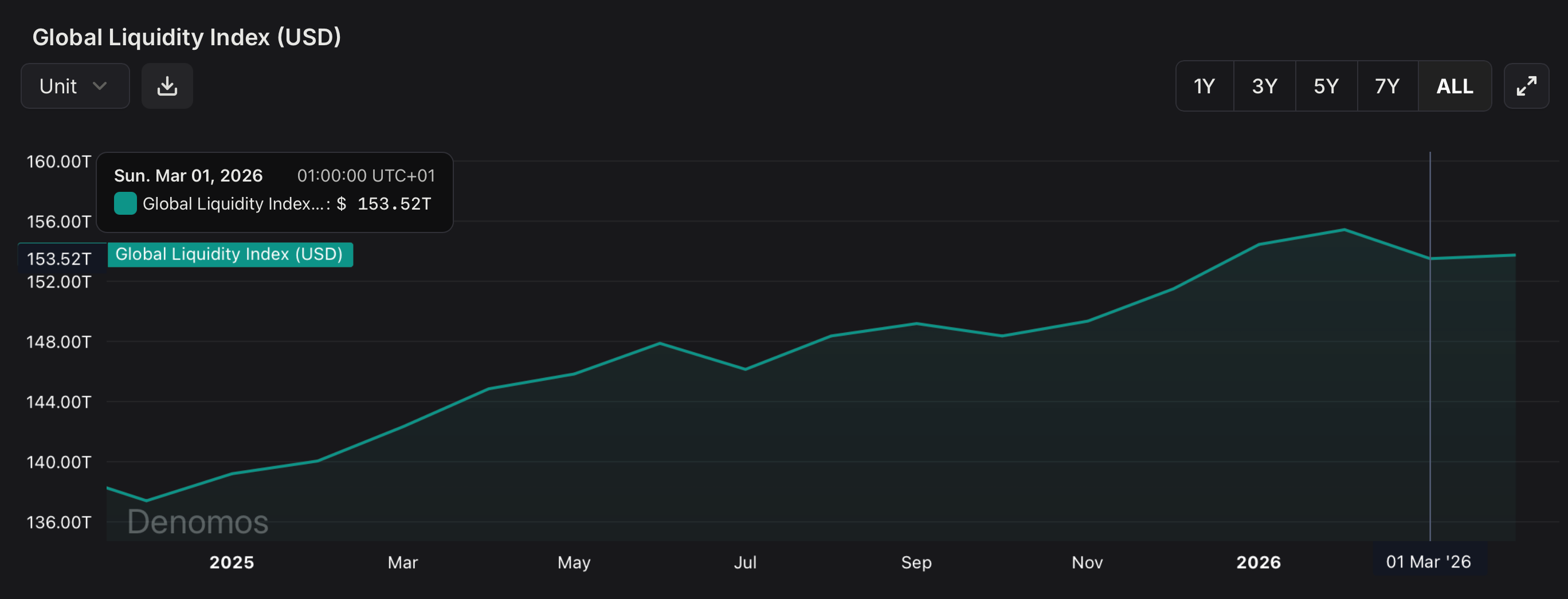
US liquidity tells a similar story, but in a more muted form. It moved from $28.44T to $28.42T, effectively unchanged. The longer trend since September 2023 is a very slow upward drift, with YoY growth sitting around 3%. That is not contraction, but it is also far from expansionary in a meaningful sense.
When these two are combined, the message is relatively clear. Liquidity is not collapsing, but it is also not accelerating. The system is in a stagnating regime.
Compared to previous cycles, especially 2020–2021, the difference is structural. Back then, liquidity expansion was aggressive and broad, allowing capital to flow into increasingly higher-risk segments over time. Today, that expansion is constrained. Supply-side pressures, particularly energy-related risks linked to geopolitical tensions and war in Iran, limit how much room central banks have to ease without reintroducing inflation.
This type of environment does not typically support a broad altcoin phase. High-beta assets tend to require accelerating liquidity, not just stable conditions. Without that acceleration, capital allocation becomes narrower and more selective.
In practical terms, this is not a setup where altcoin season is likely to emerge organically. It would require a shift in liquidity dynamics that is not currently visible.
Financial Conditions Are Looser Than Liquidity Suggests
The Financial Conditions Index by Denomos tracks how supportive the broader environment is for growth and inflation, combining liquidity, rates, credit conditions, and other macro inputs into a single framework.
The current reading is 16 on a scale from -50 to +50, which places it in moderately loose territory. Over the last six months, the trend has been gradually moving in that direction, indicating a slow easing of conditions.
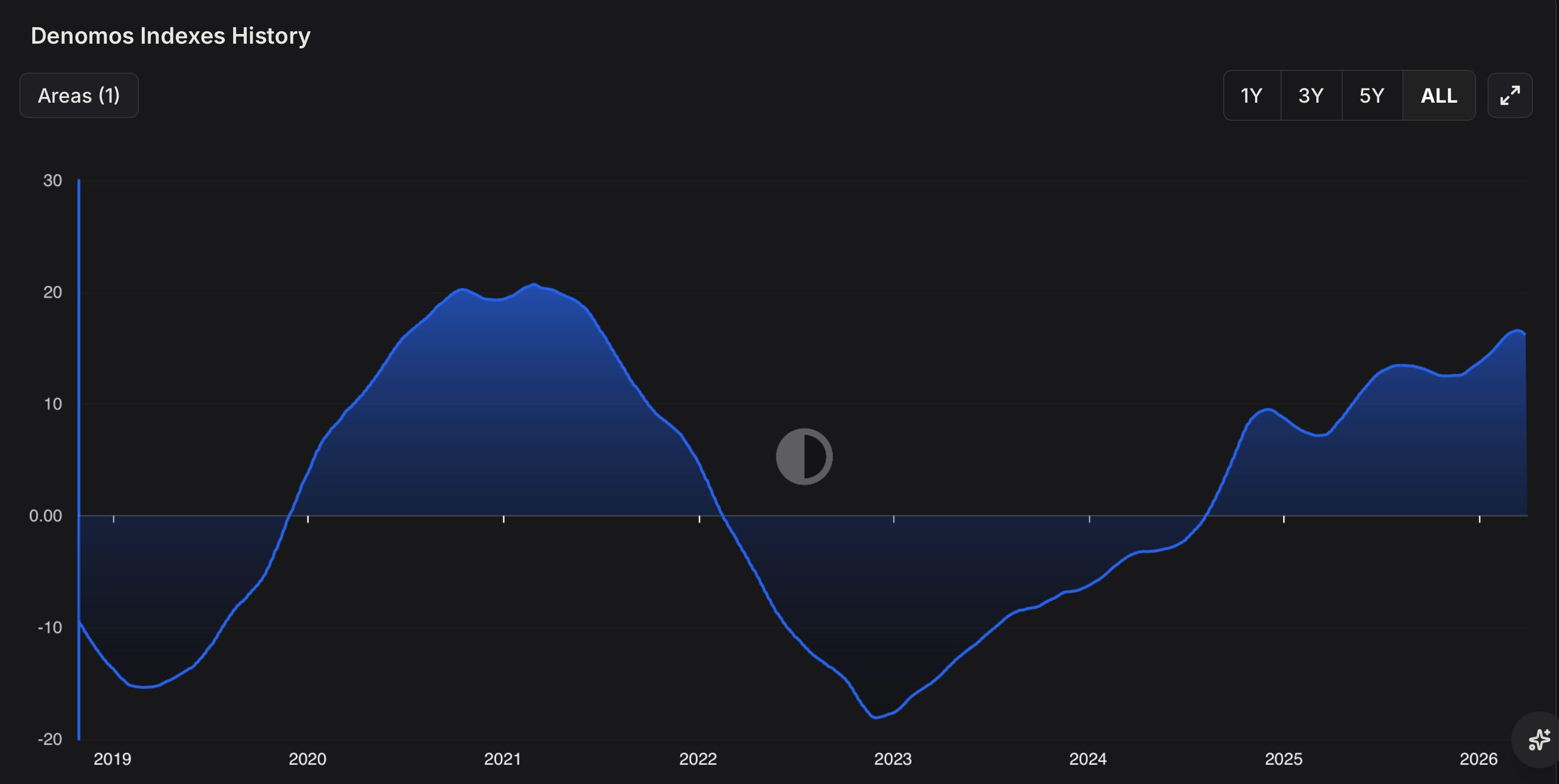
In isolation, this suggests an environment that can support risk assets (equity markets reflect that to some extent). However, when viewed alongside liquidity, a divergence appears. Liquidity is stagnating, while financial conditions are loosening. This means that support for markets is coming more from pricing conditions and expectations rather than actual monetary expansion.
A Setup That Leans Toward Inflation, Not Expansion
The current regime can be described as stagnating liquidity combined with relatively loose financial conditions and rising geopolitical uncertainty.
When similar conditions appeared in the past, the outcome was often a form of stagflation risk. Not necessarily a full regime shift immediately, but an environment where inflation pressures increase while growth does not accelerate meaningfully.
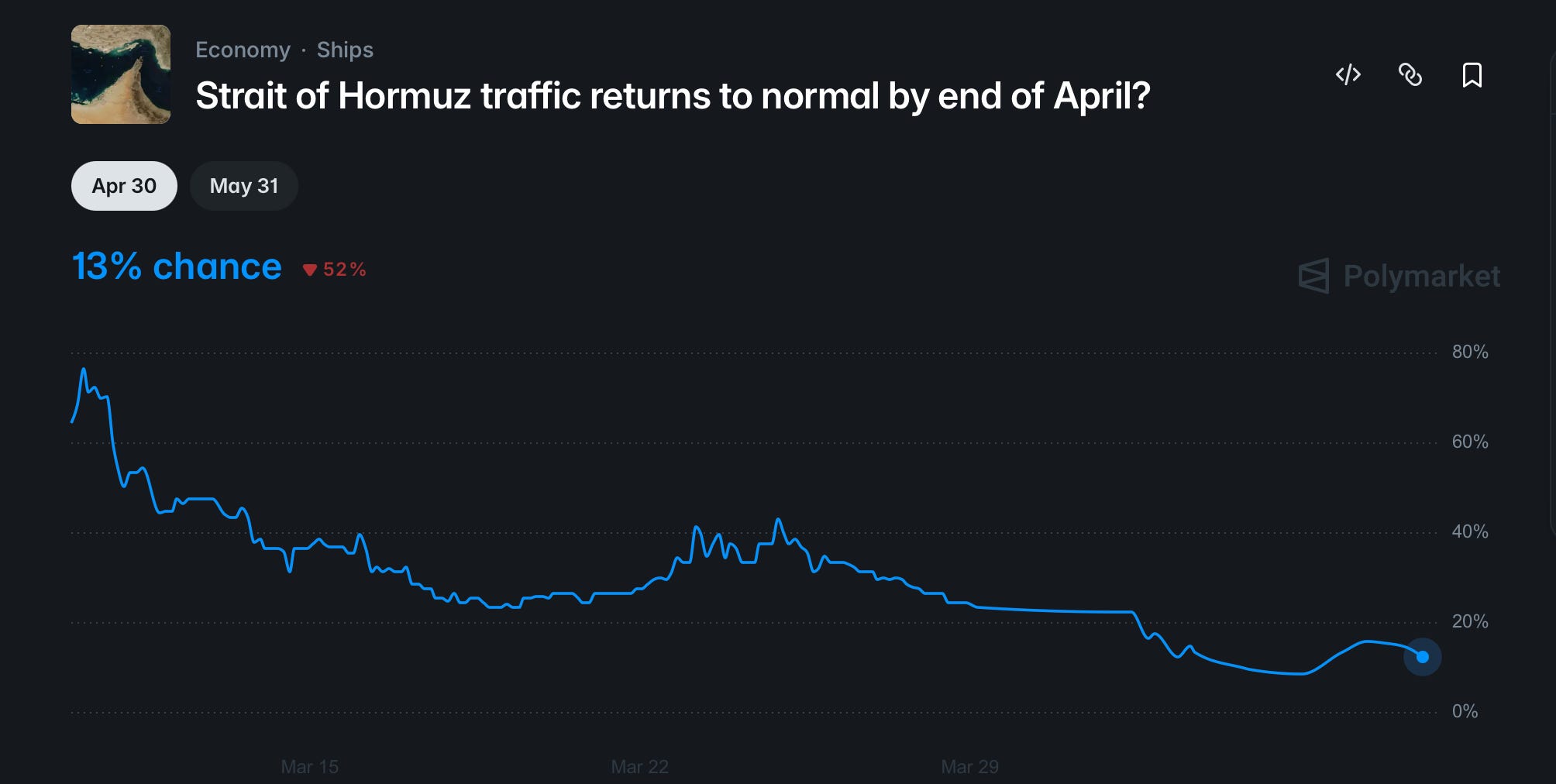
Polymarket expectations reinforce this. The probability of no rate cuts this year has increased to 42%, reflecting concerns about inflation. At the same time, only a 13% probability is assigned to the Strait of Hormuz being open by the end of April, which keeps energy-driven inflation risk elevated.
Loose financial conditions tend to precede inflation, while at the same time, the lack of liquidity expansion limits how far risk assets can extend.
This combination creates an asymmetric risk profile. Upside for high-beta assets becomes more conditional, while downside risks tied to inflation surprises increase.
The largest risk right now is not a sudden collapse, but a gradual deterioration in the inflation backdrop that forces tighter conditions later. If that happens, both liquidity and financial conditions could move in the same restrictive direction.
In that scenario, high-beta crypto assets are typically the most exposed.
Positioning for a Narrow Market, Not a Broad One
My current allocation is straightforward: 100% BTC.
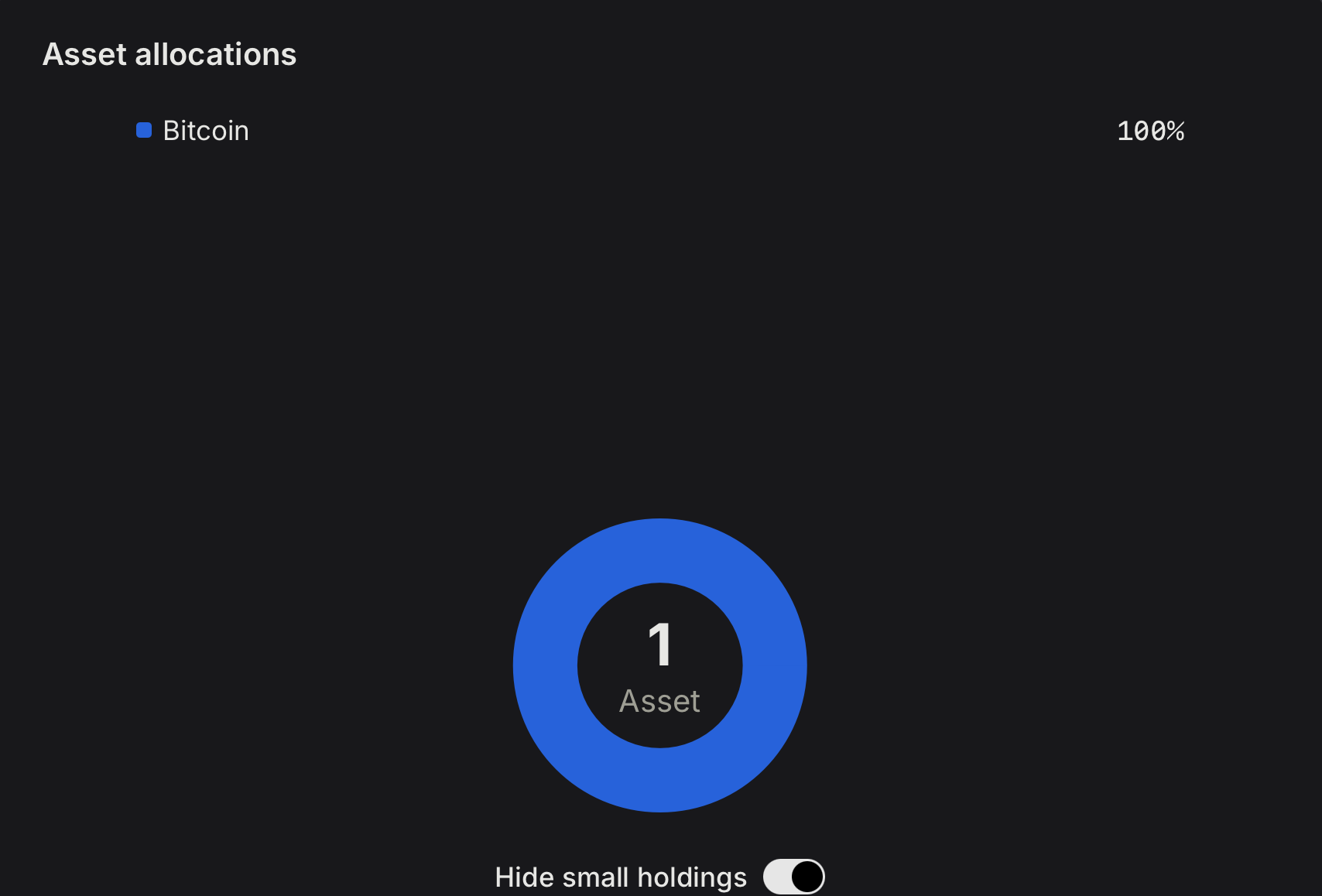
The reasoning is regime-based. In an environment where liquidity is not expanding and macro risks are rising, it is not a favorable setup for smaller or higher-risk crypto assets.
Bitcoin, while still volatile, tends to behave more like a macro asset in these conditions. It is not immune to downside, but it is structurally better positioned than the rest of the market when capital becomes more selective.
What would make me change this positioning is already starting to develop.
As the situation with the war in Iran evolves, I see a higher probability of inflation moving higher rather than lower, primarily through energy prices. In that scenario, the risk of a stagflationary setup increases, which is generally not supportive even for BTC. Because of that, I have been actively considering reallocating part of my portfolio into tokenized gold over the past few weeks.
I have not executed that shift yet, but the direction of thinking is clear. I am waiting for a specific level on the BTC/Gold ratio before acting.
What would shift my positioning toward altcoins is the opposite outcome. A meaningful and somewhat unexpected decline in inflation, potentially driven by a resolution of the conflict and a normalization in oil prices, would create a more supportive backdrop for economic growth.
In that type of environment, liquidity would have more room to expand, and the conditions required for broader participation in crypto, including high-beta assets, would start to fall into place.
One open question remains:
I’m curious how you see it.
Do you think this is a market to be in right now, or to reduce exposure?
Feel free to share your reasoning in the comments.
Closing Words
All of this comes from tracking liquidity and market conditions in a structured way.
I approach this as a retail investor, dealing with the same constraints and uncertainties as most of you. I’m also a co-founder of Denomos, where we focus on building tools that track Global Liquidity, US liquidity, and broader financial conditions through our indices.
Because understanding which regime we are in tends to matter more than trying to forecast exact outcomes.
If this type of analysis is useful to you, consider subscribing and joining the discussion. Comments are always where the most interesting perspectives show up. 🙏
And as always, this is not financial advice.
See you soon. 🍻