
In the span of two days, we got fresh PCE and CPI data. Neither points to inflation moving closer to the Fed’s target. If anything, the trend is starting to move in the opposite direction.
Inflation is not falling despite relatively high interest rates, while new risks, particularly from energy markets, are starting to build on top of that.
For crypto, this type of environment tends to narrow the opportunity set rather than expand it.
In this post, I break down what the latest inflation data actually tells us, how other indicators confirm or contradict that picture, and how I’m positioning in crypto as a result.
📬 In this issue:
What CPI and PCE are signaling right now
Whether other indicators confirm that signal
What this means for the current crypto regime
Before we dive in, one small favor: If you find this analysis useful, consider hitting the ❤️ button or sharing the post.
It helps this reach other retail investors trying to understand the same environment.
Let’s get into the data.
Inflation Remains Elevated and Starts Re-Accelerating
In early April, we received two key data points. PCE for February and CPI for March. Both show that inflation is not moving toward the 2% target in a meaningful way.
PCE increased by 0.4% month-over-month and is up 2.8% year-over-year. Core PCE, which is more relevant for policy, also rose 0.4% monthly and sits at 3% YoY. What stands out more is the longer trend. Core PCE has been stuck in the 2.6% to 3% range for roughly two years.
CPI for March confirms the same direction, but with more acceleration. Headline CPI is now at 3.3% YoY, a 0.9% increase compared to the previous month (which is huge!!!). A large part of this move is tied to energy prices, which have been rising since the beginning of the US/Israel-Iran conflict. Core CPI also moved higher, from 2.4% to 2.6%.
This creates a specific type of environment. Inflation is not volatile in a downward direction. It is stable at levels above target, with signs of re-acceleration.
Compared to past cycles, this resembles periods where inflation becomes persistent rather than transitory. Even with relatively restrictive rates, price pressure does not fully normalize.
Energy Pressure Builds While Inflation Indicators Diverge
Beyond CPI and PCE, other inflation inputs point in a similar direction, although not always with the same intensity.
On the supply side, oil prices are currently in the $95–100 range. That is already elevated, and the ongoing situation between the US and Iran does not suggest relief in the near term. Each additional disruption increases the probability of further energy-driven inflation.
On the demand side, indicators such as Core PCE and pricing components in surveys are also showing persistence. The signal is less sharp than on the supply side, but it still points toward underlying price pressure that is not fully contained.
Breakeven inflation sits around 2.3% and with an uptrend potential, which implies that investors expect inflation to remain above the Fed’s target over the coming years.
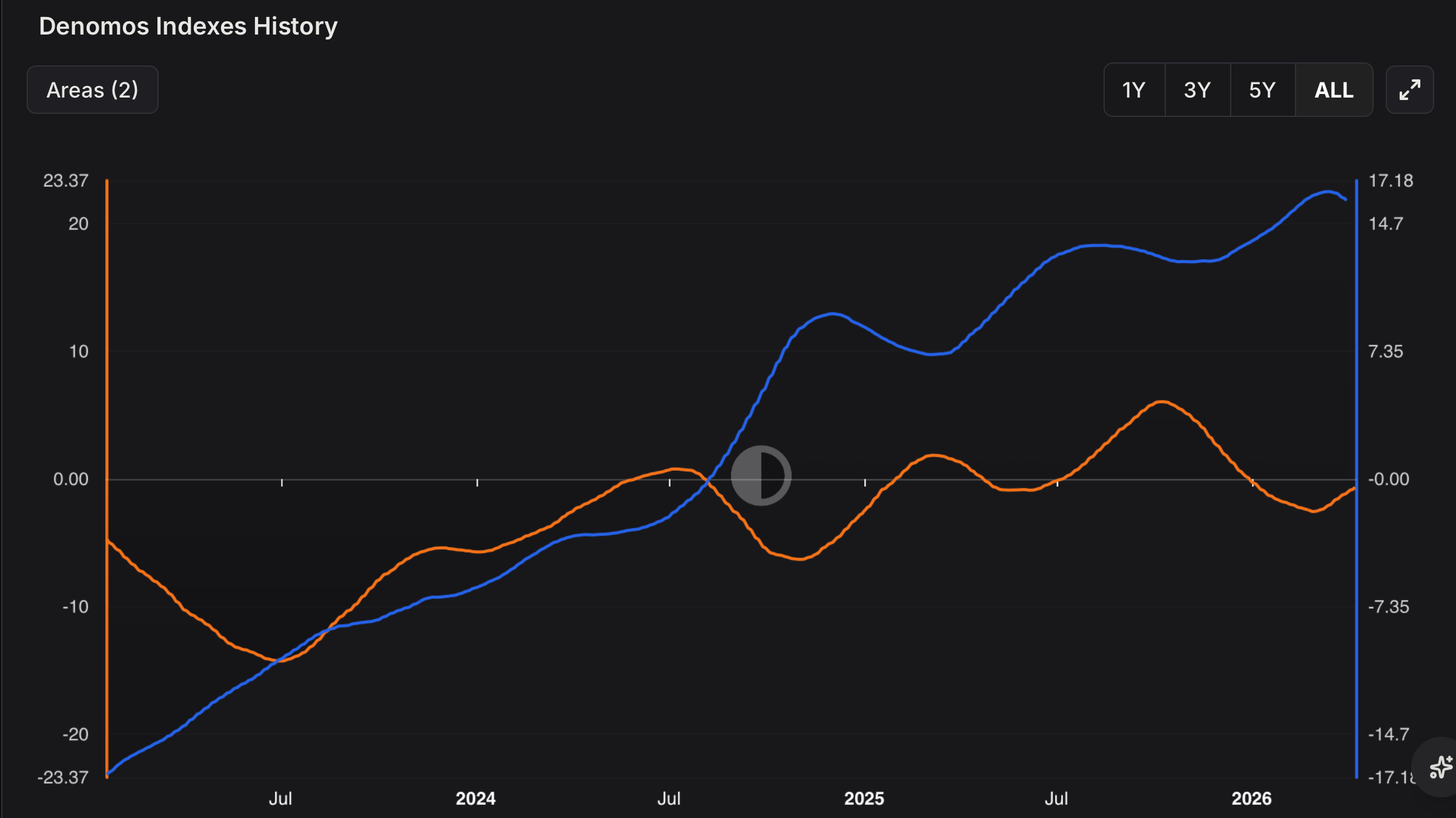
The Denomos Inflation Index tracks how price pressures evolve beyond headline data, including expectations and leading inputs. The current value is -1.3 on a scale from -50 to +50, which still leans slightly toward a neutral setup within an uptrend since mid-2023.
However, we can observe a divergence between the Financial Conditions Index and the Inflation Index. The Inflation Index remains in neutral territory and in a slow uptrend, while the Financial Conditions Index has been loosening at a faster pace for some time. Historically, such gaps tend to resolve with inflation moving higher in the coming months, which further confirms the direction we are heading.
Inflation Risk Limits Policy and Market Expansion
The current regime is defined by persistent inflation, rising energy risk, and relatively loose financial conditions compared to the state of the economy. When inflation remains elevated and financial conditions are not restrictive enough, the typical outcome is further inflation pressure in subsequent months.
Moreover, the current geopolitical situation acts as an additional catalyst for the high-inflation risk. In such an environment, policy flexibility is limited, and rate cuts become less likely.
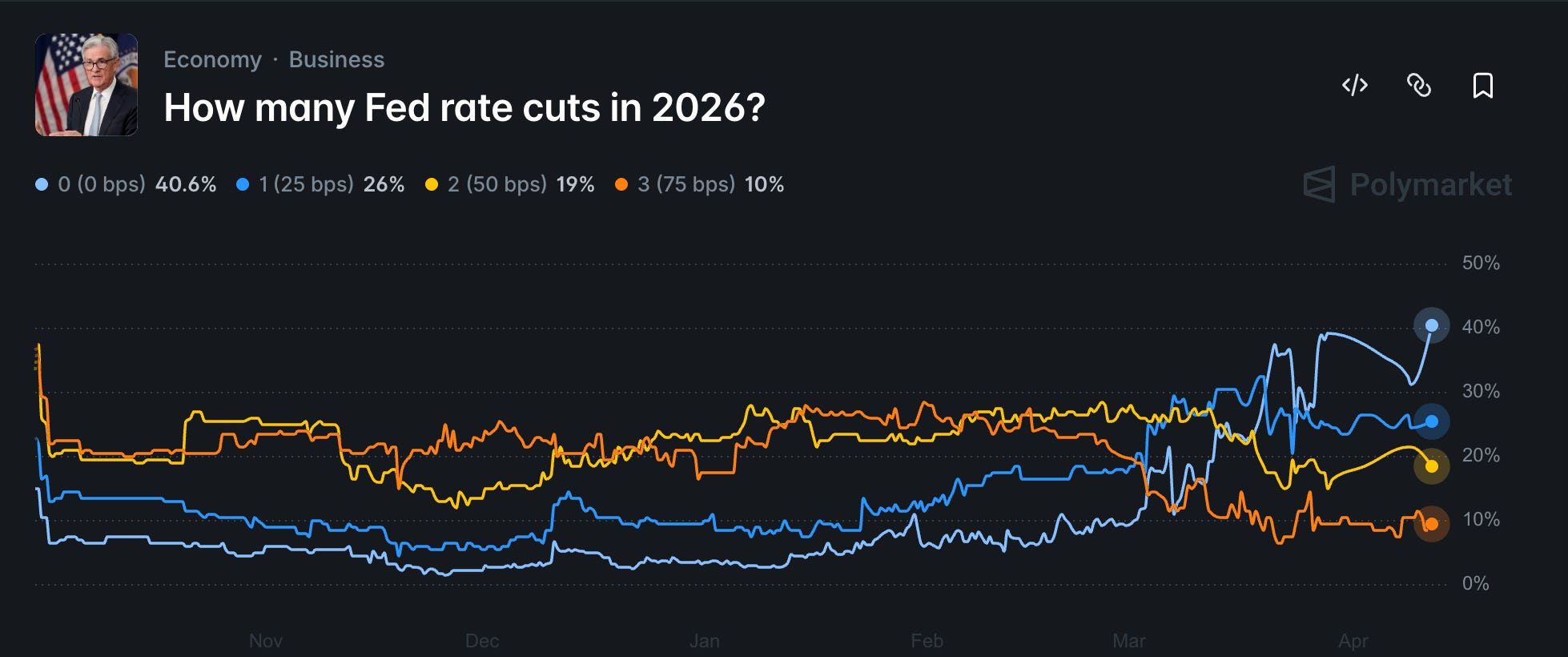
Polymarket expectations align with this view. More than 40% of participants expect no rate cuts this year, while over 80% assign a high probability to inflation reaching the 3.5% to 4% range by year-end.
For the crypto market, this creates a constrained setup. Without easing, liquidity does not expand meaningfully and without expanding liquidity, most altcoins struggle to sustain upward moves.
But there is also a secondary risk. If supply-driven inflation continues to rise (which is likely), central banks may be forced to tighten further and more decisively, as alternative approaches by the Fed have historically proven ineffective. This scenario would also be negative for altcoins in the short to mid-term.
In fact, this scenario may be the most realistic outcome. Financial conditions appear too loose for the current environment, while inflation pressures are building. So, to be completely honest, we shouldn’t be waiting for rate cuts. We should be preparing for potential rate hikes.
Given all of the above, I strongly believe the environment remains challenging for broad crypto exposure.
Positioning for a Constrained Crypto Environment
My current allocation remains unchanged. 100% BTC, with plans to potentially reallocate part of the capital into gold.
Since my first post where I started tracking performance publicly, the portfolio is down approximately 16–17% (you can see the starting point here)
The reasoning behind this positioning is based on the current regime. The risk of holding altcoins remains elevated. In environments like this, that phase can last longer than expected, and drawdowns can extend further than most anticipate.
I also believe that altcoins still have room to decline from current levels. Without a clear shift in inflation and policy expectations, there is little structural support for a broad recovery.
What would change my view is a clear and sustained decline in inflation. At the moment, I do not see a path for that to happen in the near term.
But my question to you is:
I’m curious how you see it. Let me know your reasoning in the comments.
Tracking Regimes Instead of Narratives
All of this comes from tracking inflation, growth, and market conditions in a structured way.
I’m approaching this as a retail investor, navigating the same uncertainty as most of you. I’m also a co-founder of Denomos, where we focus on tracking key macro indicators and building indices that help interpret the current regime for crypto investors.
Each week, I break down how liquidity, inflation, and growth interact and what that tends to mean for crypto markets.
The goal is not to predict exact outcomes, but to stay aligned with the environment, because I believe that’s the best path to long-term success.
If this type of analysis is useful, consider subscribing and joining the discussion.
Also, feel free to share your perspective in the comments.
As always, this is not financial advice.
See you again soon! 🍻