
👋 Welcome back.
I had a long week. I became a father to two more daughters, and I am still adjusting to that reality. At the same time, I’m glad I managed to sit down and write this while enjoying family life.
Since last month, not much has improved on the macro side. The conflict in the Middle East continues, and with it the risk of energy-driven inflation. The uncertainty is not going away. If anything, it is becoming more embedded in expectations.
Right now, the most important point in my view is simple: inflation risk is not resolving. Our indexes suggest that the probability of higher inflation over the next 12 months remains elevated.
None of this points to a supportive environment for risk assets, including Bitcoin.
This weekly article focuses on two things: understanding where financial markets are likely heading and introducing the Denomos indices that help frame which crypto assets make sense to hold in the current environment.
📬 In this issue:
What Denomos indices actually measure
Current readings
Regime interpretation
Crypto implications
My positioning
What would change my view
Closing thoughts
Before we dive in, one small favor: if you find this useful, consider hitting the ❤️ or sharing it. It helps this newsletter reach other crypto retail investors who are trying to make sense of the same questions.
As a fellow retail investor, I’ve been tracking this closely, so let’s break it down simply.
What Denomos Indices Actually Measure
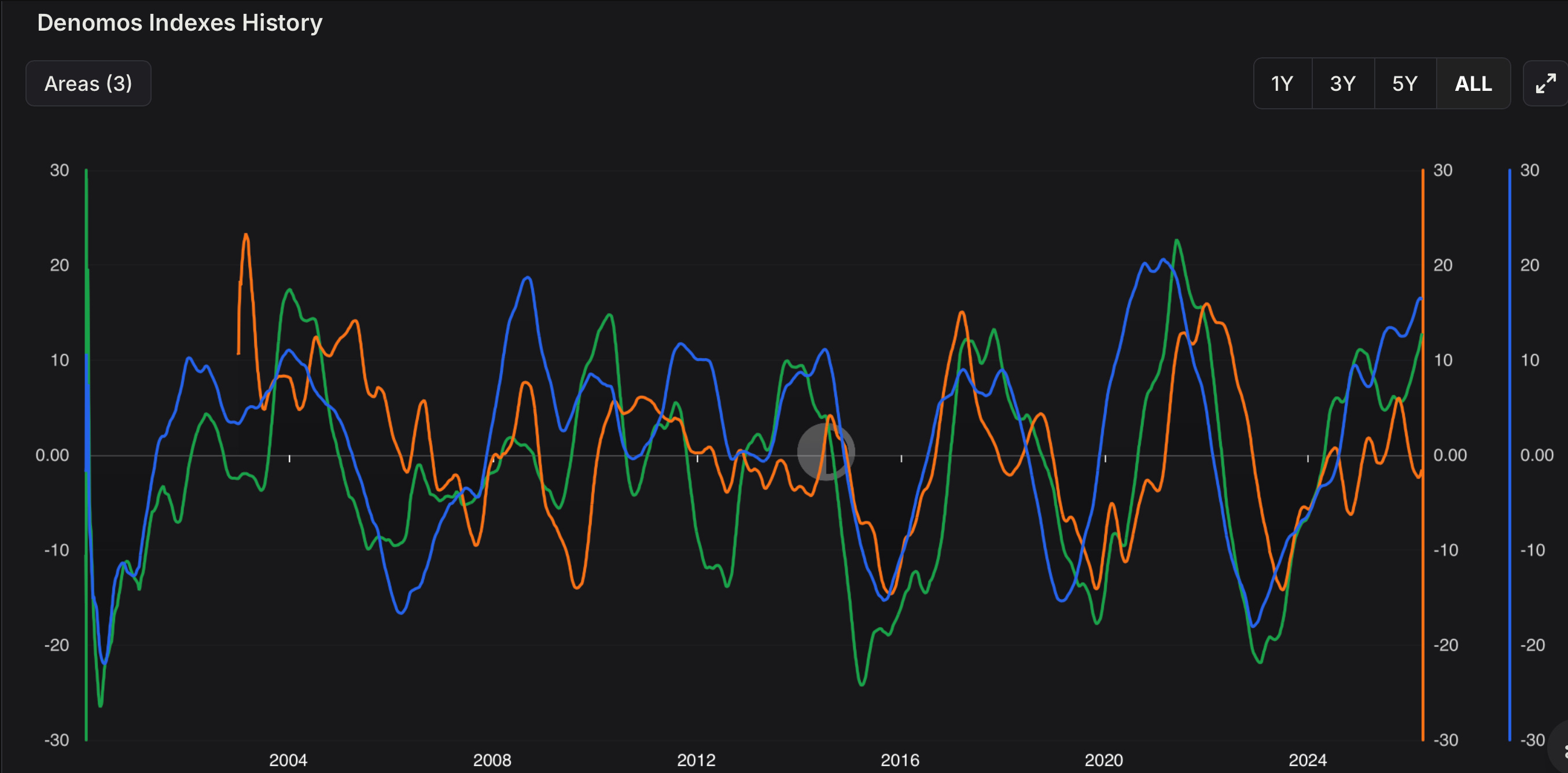
Denomos indices are my way of simplifying something that is, in reality, quite complex.
Each of them is built from a broader set of inputs, around 30 parameters in total, looking at both current levels and trends. The goal is not to rely on a single indicator, but to understand the broader picture.
The growth index looks at whether economic activity is expanding or slowing down. That includes things like business activity, credit conditions, and how different parts of the economy are behaving beneath the surface.
The inflation index tracks how price pressure is evolving. Not just the headline numbers, but also market expectations and inputs that tend to move before inflation shows up in official data.
The financial conditions index focuses on the environment around both. Liquidity, the bond market, and monetary policy all play a role in determining how much room the system actually has to move.
Current Index Readings
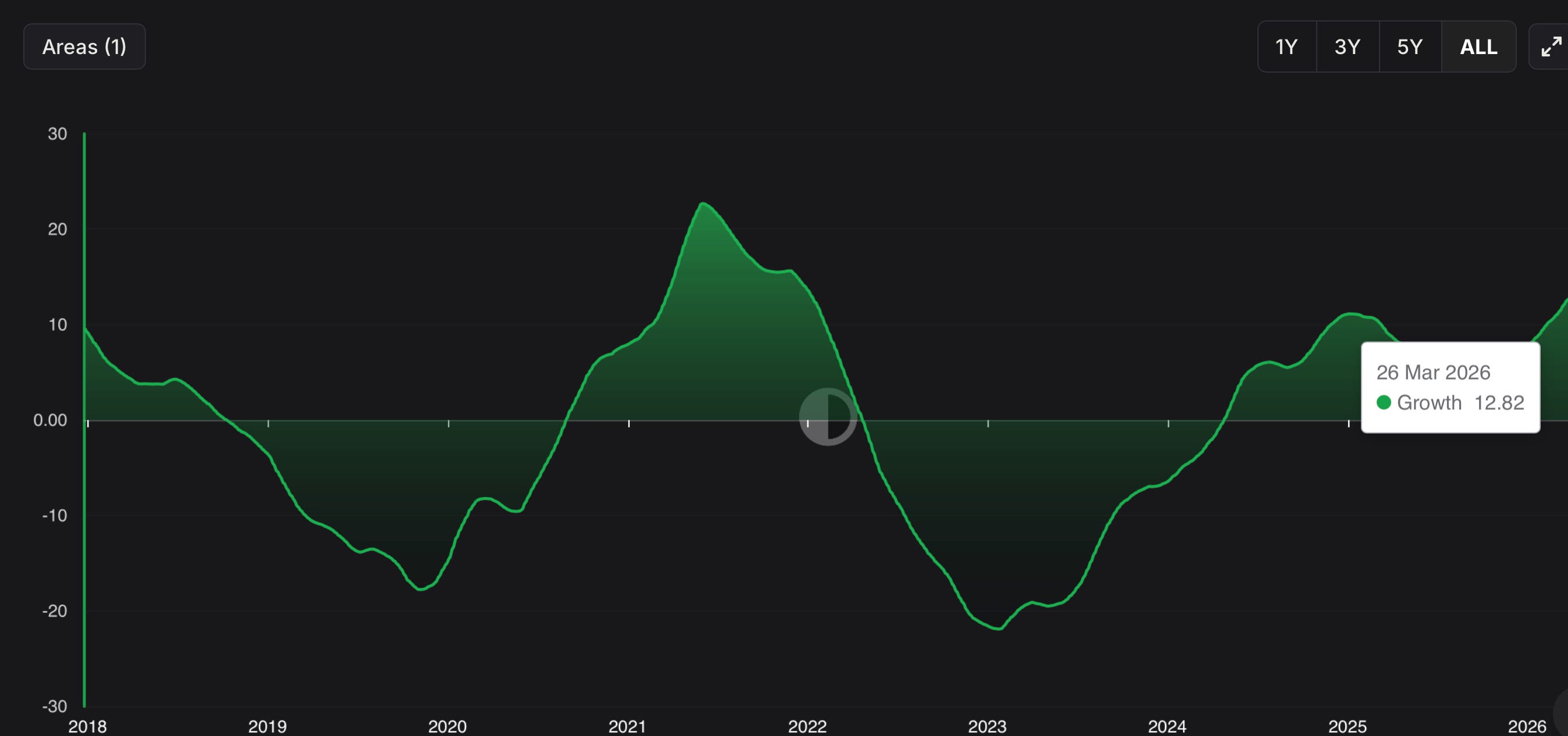
Growth Index
The current level is 12.8, on a scale where -25 represents strong contraction and +25 strong expansion.
The trend has been upward since late January 2023. Even if it does not feel intuitive, the system continues to signal expansion in underlying economic activity. From a data perspective, business conditions have been improving for quite some time.
Inflation Index
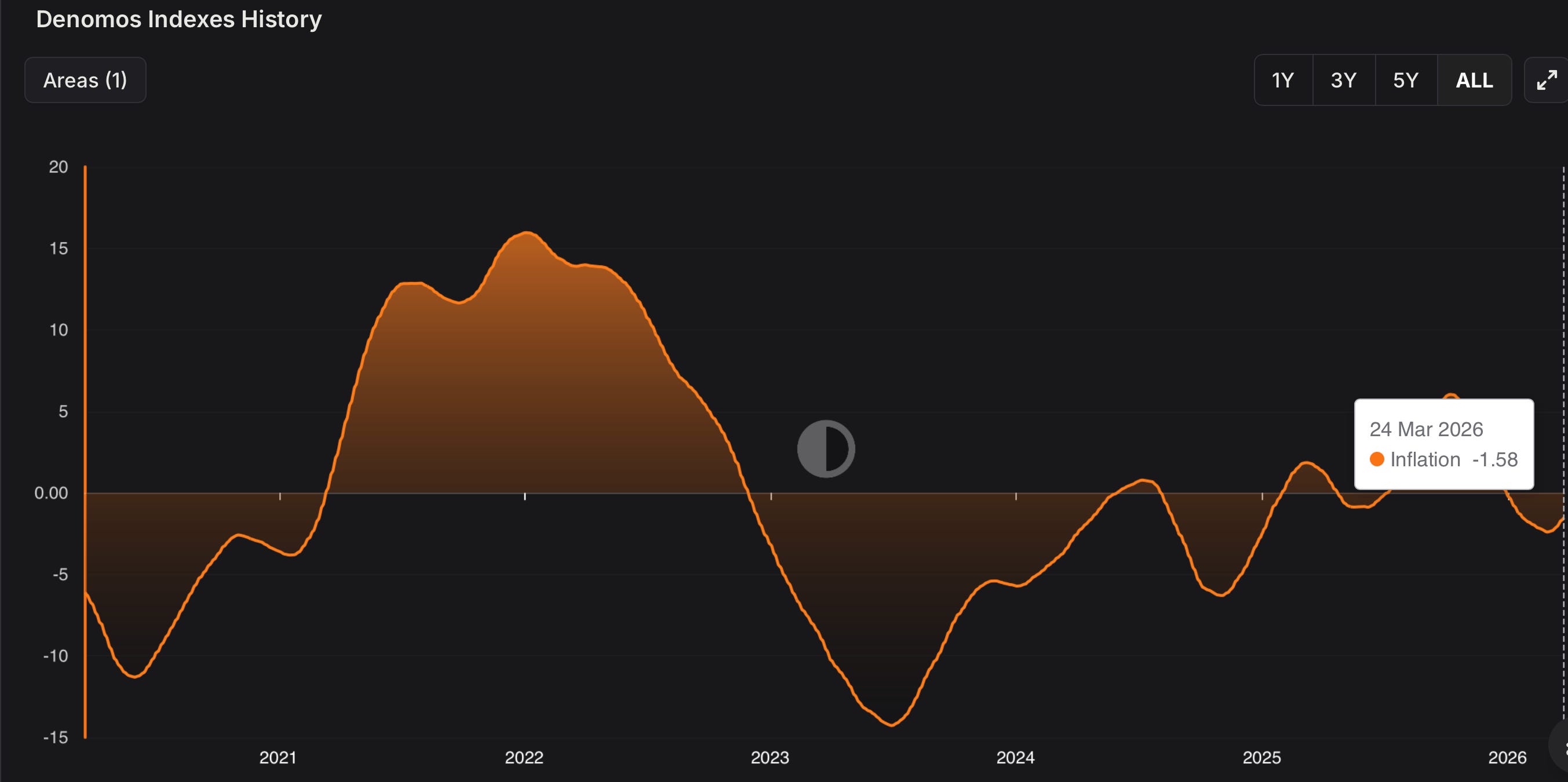
The current level is -1.6, which places it near neutral but still slightly on the deflationary side.
The trend has been upward since mid-2023, with periodic pullbacks within that broader move. This is where my own expectations diverged from the data. I assumed inflation pressure was already high. The index suggests something different. It is more likely that what feels like inflation risk is still largely forward-looking, driven by uncertainty, especially around geopolitical developments.
Financial Conditions Index
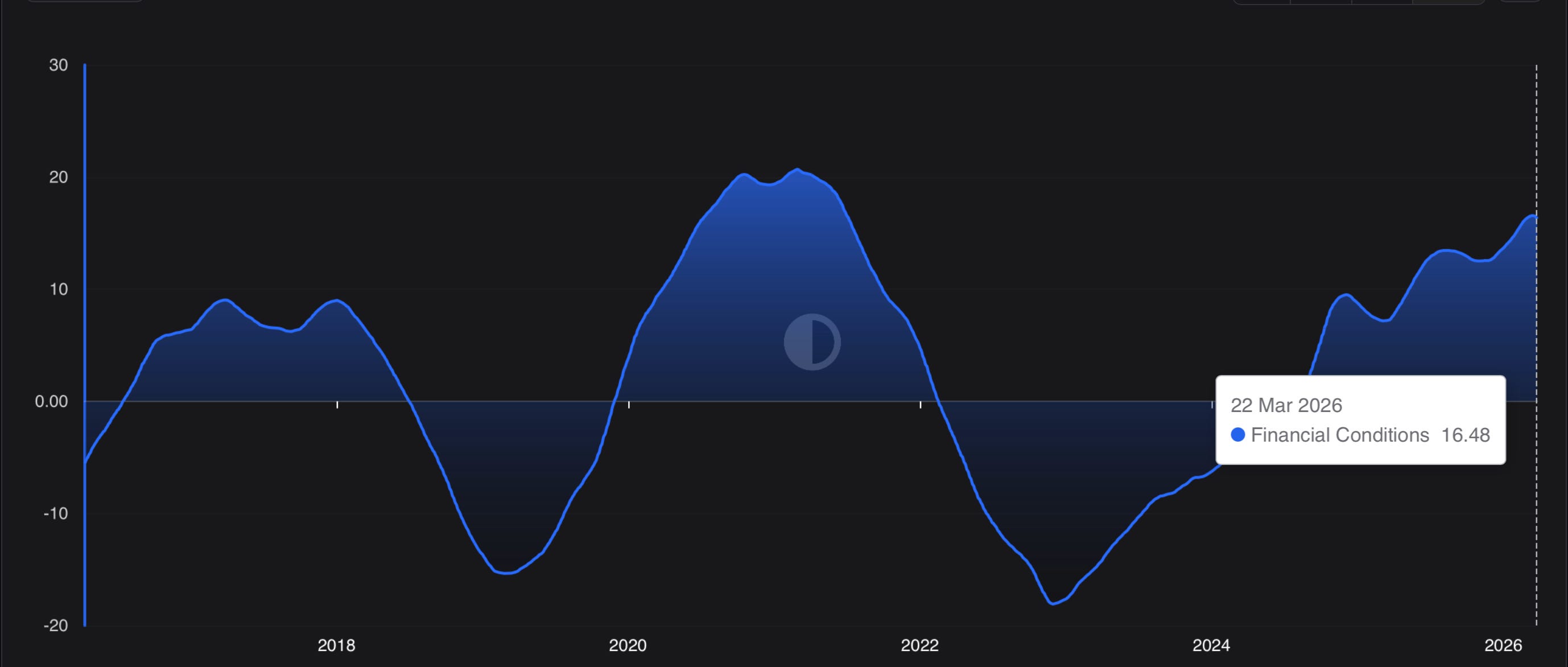
The current level is 16.3, where -20 represents very tight conditions and +20 very loose ones.
The trend has been easing since late 2022. Despite the common perception that conditions are restrictive, the index shows the opposite. Financial conditions are relatively loose, at levels higher than what we have typically seen over the past two decades.
Regime Interpretation
When combining the three indices, the current regime can be described as follows:
Growth is positive, inflation is still contained but trending upward, and financial conditions are loose.
This combination is important. It suggests an environment where economic activity continues without immediate inflation pressure, but with conditions that could allow inflation to build over time.
We have seen a similar setup before. During the 2020–2021 period, growth and financial conditions moved first, while inflation followed with a delay of several months. In that case, the lag was significant.
The current structure resembles that phase, although the drivers may differ. Back then, liquidity expansion played a central role. Today, the likely source is less about new liquidity and more about supply-side pressure, particularly energy.
My base assumption is that inflation has not yet fully expressed itself in the data. Instead, it is in the process of building, and the next 12 months may reflect that shift more clearly.
Crypto Market Implications
If we looked only at the similarity with the Covid period, one could argue that this setup precedes a strong risk-on phase, including altcoin outperformance.
That would probably be a mistake.
The key difference is liquidity. During Covid, financial conditions were not just loose, they were supported by aggressive monetary expansion. Cheap capital enabled broad risk-taking across markets, including crypto.
This time, liquidity is not expanding in the same way. At the same time, geopolitical uncertainty remains elevated.
Altcoin season depends on conditions and right now, those conditions are not aligned.
If inflation does accelerate over the next 12 months, the implications become more complex. Inflation driven by energy costs can strain the system rather than support it. In that scenario, gold tends to outperform high-beta assets.
At this stage, the data suggests that being positioned in tokenized gold may be more consistent with the regime than holding altcoins.
I am relatively confident about the direction of inflation. What remains uncertain is the exact trigger.
Until that becomes clearer, I see limited downside in considering exposure to tokenized gold. This is not financial advice. It is simply how I am interpreting the current setup.
My Positioning + Performance Update
My current allocation remains unchanged: 100% BTC.
That said, I am not satisfied with the current environment. The signals are not clean, and the risk profile is shifting.
If conditions remain similar, I am considering reallocating part of my capital into tokenized gold. The level I am watching is around 0.06 on the Gold/BTC pair. That is where I would likely start rotating some exposure.
Since my first Substack post, the performance is around -25%.
(Original post: https://mladenpavla.substack.com/p/holding-altcoins-right-now-is-a-risky)
I think it is important to keep this transparent. The goal here is not to present perfect outcomes, but to show how the framework behaves in real time.
What Would Change My View
There are a few conditions that would make me reconsider this view.
First, if inflation does not meaningfully increase over the next 12 months, the current interpretation would need to be reassessed.
Second, if liquidity, both in the US and globally, starts expanding again, that would change the structure. Although I find that unlikely under current inflation risks, it remains a possibility.
Higher liquidity in an already loose environment could create a different dynamic, but it would also increase the risk of more extreme inflation outcomes.
Closing
I’m a retail investor, just like most of you reading this. I’m also a co-founder of Denomos, an analytics platform built specifically for crypto retail investors.
All the data mentioned in this post comes from the Denomos indices. The goal of these indices is to simplify the macro picture without oversimplifying reality. Looking at only a few indicators often leads to distorted conclusions. A broader system helps reduce that bias.
On Denomos, you can track these indices in real time and see how different market regimes develop.
If you want weekly analysis like this, focused on understanding where we are and what assets make sense to hold, consider subscribing to this Substack. 🙏
The goal is to recognize conditions early enough to act rationally.
Thanks for reading. 🍻
This is not financial advice. It is my interpretation of the data. Always do your own research and manage risk accordingly.