
If you are reading Mladen’s newsletter, you probably check charts more often than you check your kid’s math homework. That is not an insult. It is an observation. You care about markets. You think about risk. You are trying to position yourself well in a world that feels unstable.
You study Bitcoin dominance. You debate whether altcoins are entering accumulation or distribution. You think about liquidity, macro cycles, and market structure.
But here is the uncomfortable question.
Are you positioning your kids too?
Not with an inheritance. Not with a college fund alone. I mean mentally. Are you preparing them to manage the financial world they are growing up in?
Because that world is not your parents’ world. It is not even yours.
Your child’s first exposure to investing might not be 401k. It might be a TikTok explaining how someone turned $200 into $20,000 trading meme coins. Their first experience with credit might be Buy Now Pay Later at checkout. Their first lesson about wealth might be watching influencers make money from attention in real time.
If that seems overstated, consider how many adults still don’t grasp interest rates.
Financial literacy is not about raising tiny portfolio managers. It is about raising adults who are not financially fragile.
There is a difference.
Most of us learned about money the hard way. We learned when we over drafted. When we signed student loans without understanding compounding. When we panicked, we sold it. When we FOMO’d. When we realize income is not the same as wealth.
We learned through mistakes.
Your kids do not need to learn everything through mistakes.
You already understand volatility. You have watched markets move hard based on narratives, liquidity, and emotion. You know price and value are not the same thing. You know hype fades. You know risk management feels boring until it saves you.
Those lessons apply far beyond crypto.
When you teach a teenager that a 10x return usually comes with heavy risk, you are also teaching them how to think about decisions. When you explain why you did not chase a pump, you are modeling discipline. When you talk through a drawdown calmly, you show them how to handle pressure.
That is financial literacy in real life.
Here is something else most people do not say out loud. The biggest risk in markets is rarely the chart. It is behavior.
People do not blow up because volatility exists. They blow up because emotion takes over.
If you understand that, you already know why early exposure matters.
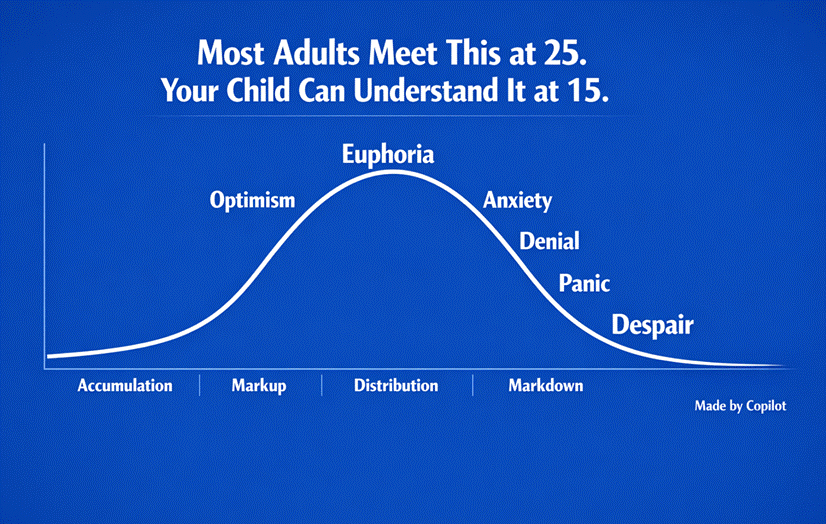
Most adults experience that cycle for the first time with real money on the line. That is when the lesson is expensive.
But a teenager can learn the same pattern in conversation. They can understand that euphoria clouds judgment. That panic makes people sell bottoms. That patience often feels uncomfortable.
You are not teaching them how to trade. You are teaching them how people behave under pressure.
And that applies everywhere.
Financial literacy reduces anxiety because clarity reduces fear.
Adults who do not understand money often avoid it. They avoid looking at statements. They delay decisions. They carry quiet stress around debt. They mistake income for security.
Clarity changes that.
Kids also learn by watching you.
If they see you panicking at every red candle, they learn anxiety.
If they see you stick to a plan, they learn discipline.
If they see you admit mistakes, they learn maturity.
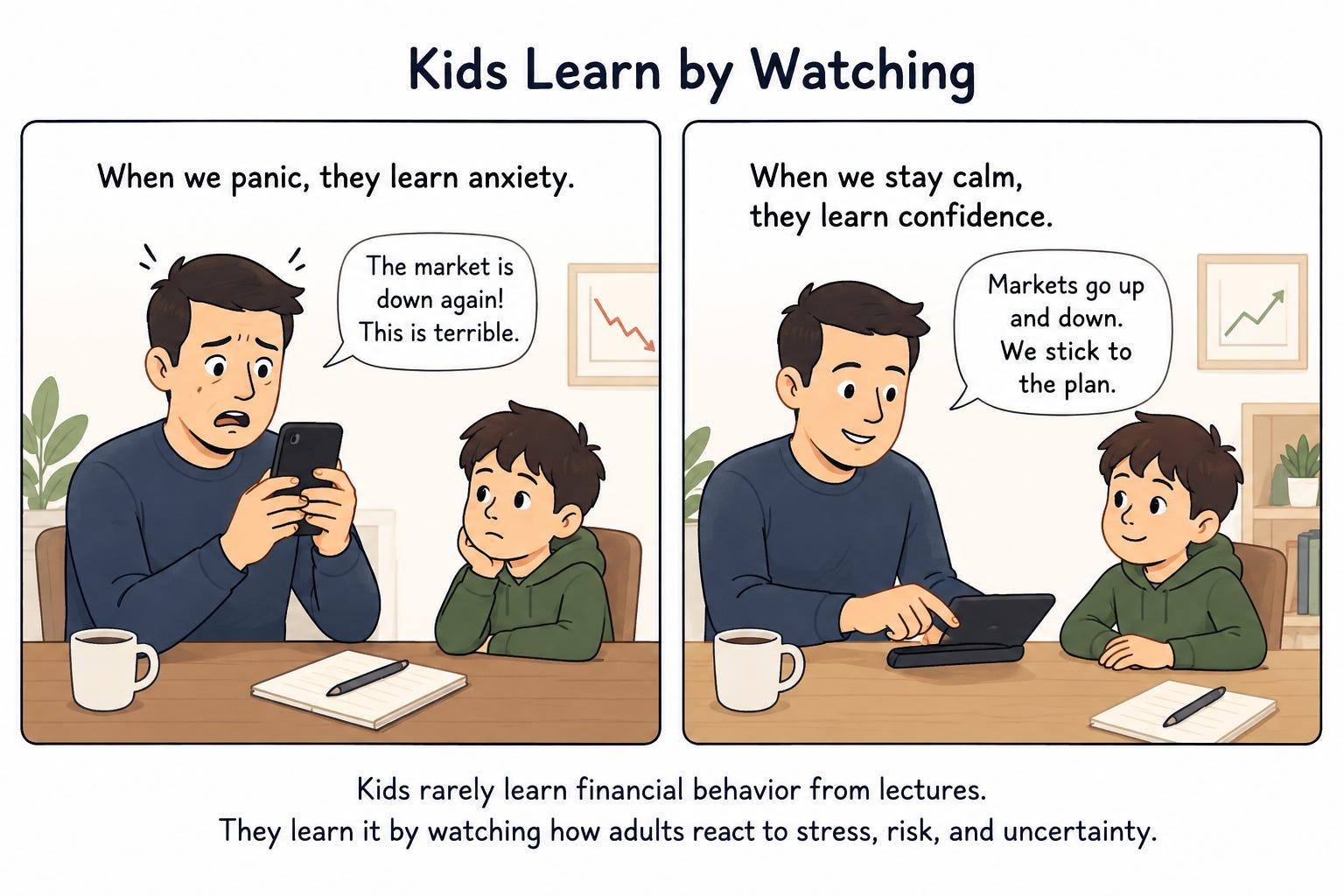
It is funny because it is true. Your kids hear more than you think. If they hear you talk about markets all the time, they are already forming ideas about risk and money.
The question is whether you are guiding that learning.
Now let us talk about time.
If your child understands investing at 18 instead of 30, that is not just a twelve-year head start. It is decades of better decisions.
And it is not only about starting early. It is about starting with structure.
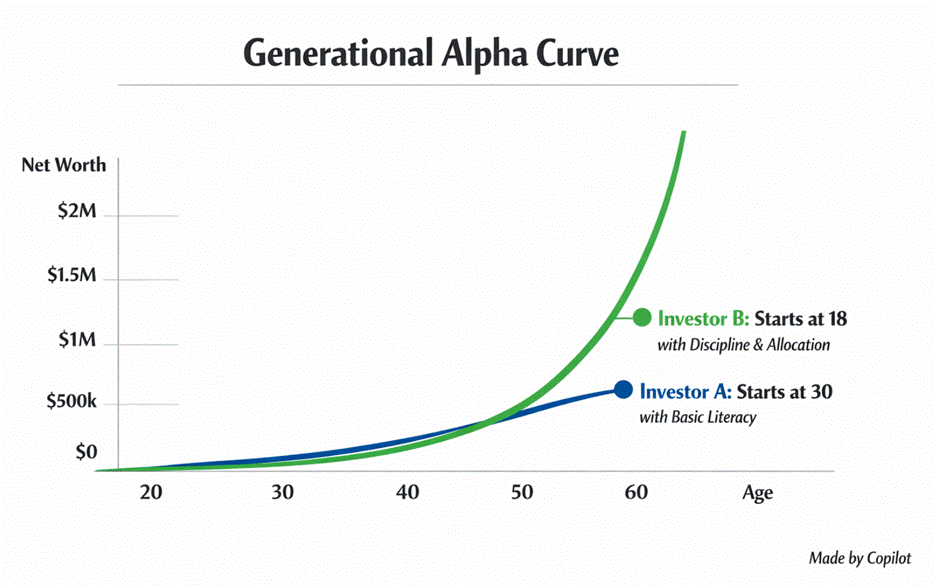
The difference is not magic returns. It is better decisions made for longer.
You already understand this in markets. Process matters. Discipline matters. Time matters.
Now think about legacy.
Many people focus on building wealth. Fewer focus on transferring understanding.
And history shows what happens when money transfers without knowledge.
If you build wealth but do not transfer financial competence, you are handing your child opportunity without an instruction manual.
Money without understanding can disappear fast. We have seen it in every cycle. Fast gains. Faster losses. Sudden wealth followed by bad decisions.
Teaching finance early is not about turning your child into a trader. It is about giving them judgment.
That matters even more in today’s world.
Your kids are growing up in an attention economy. They see followers and assume wealth. They see lifestyles and assume stability. They see visibility and assume ownership.
But attention is rented.
Assets are owned.
Which brings us to a conversation that might happen one day.
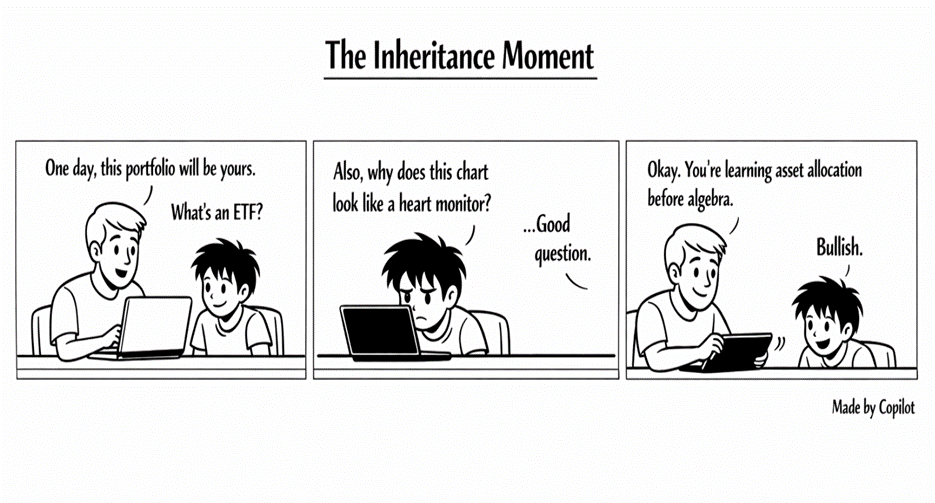
It is a joke. But it is also realistic.
You can build a strong portfolio and still leave your kids unprepared to manage it.
Financial literacy teaches more than investing. It teaches patience. It teaches trade-offs. It teaches how to evaluate risk before jumping in.
Teaching financial literacy is really teaching how to think under uncertainty.
And uncertainty is not going away.
You already spend hours thinking about positioning. You rebalance. You manage downside. You think long term. You adjust when data changes.
The real question is whether you are applying that same level of thought to your kids’ financial mindset.
Because the most asymmetrical bet you can make is not a token.
It is early financial understanding.
That return does not depend on market timing. It depends on you.
One of the reasons I wanted to publish this guest post is because I think financial literacy inside families is still massively underestimated. Studies show that around 70% of wealthy families lose their wealth by the second generation, and roughly 90% by the third. Building wealth is clearly not enough. Transferring knowledge matters just as much.
As a father of three small daughters, I think about this a lot myself. I want my kids to grow up with better financial understanding than I had, and honestly, I feel a huge responsibility not to get that wrong.
That is why I think Madam Finance deserves attention, especially if you are a retail investor with kids or someone who wants to prepare their family for a more complex financial future.