
Welcome to the first post in a new series focused on the intersection between crypto and AI.
I see these two technologies as among the most important developments for the next 10–20 years, primarily because of how well they fit together. In an agent-driven world, where software acts on behalf of users, you need financial rails that are always online, low-cost, and permissionless. Today, blockchains are one of the few systems that meet those conditions.
This post would not be possible without Vini from 「thecoding」, who co-authored it. He is deeply involved in the NEAR ecosystem and runs a validator, which gives him a practical perspective beyond theory.
In this article, you will find a breakdown of what NEAR Protocol is, how it is positioned around AI, and how it compares to other “AI” crypto projects.
If you want to follow this space more closely, consider subscribing for future updates.
What is NEAR and Why It Is Positioned for AI
NEAR is a general-purpose blockchain, similar in category to Ethereum or Solana, but with one key difference. It was built with AI use cases in mind from the beginning.
The team originally started as an AI company in 2017. They transitioned to building a blockchain in 2018 because they needed infrastructure to support fast, low-cost, and reliable transactions for AI-related systems. That origin still shapes the design today.
One of the key differences with NEAR Protocol is how naturally AI agents can interact with the network. On many blockchains, agents have to rely on external tools and libraries that weren’t specifically designed for that environment. It’s a bit like trying to use a general-purpose app for a very specific task. It works, but not perfectly. This added layer slows things down and increases the chances of errors.
NEAR takes a different approach. Instead of forcing developers to adapt generic solutions, it provides purpose-built tools designed specifically for AI agents. One example is the “Shade Agent stack,” which acts as a native toolbox. With it, agents can directly interact with smart contracts and execute transactions without needing complex workarounds. In simple terms, NEAR reduces the distance between AI agents and the blockchain itself. The result is a smoother, more reliable experience, where agents can operate faster, with less overhead and fewer points of failure.
Another important part of the ecosystem is NEAR AI Cloud. It’s a platform where developers and companies can run AI models, deploy agents, and manage how those agents interact with different services. Instead of stitching together multiple tools, everything can be handled in one place. For example, developers can deploy agents like IronClaw—an open-source, security-focused alternative to OpenClaw—and run them directly within the environment. Payments for usage, such as API calls or compute resources, can also be processed seamlessly through the network.
One of the key ideas behind NEAR AI Cloud is privacy. The system uses secure environments designed to keep data protected while it’s being processed. In simple terms, sensitive information stays confidential, even while it’s actively in use. At the same time, interactions can be verified using cryptography, which means you can trust that everything happened exactly as intended without exposing the underlying data.
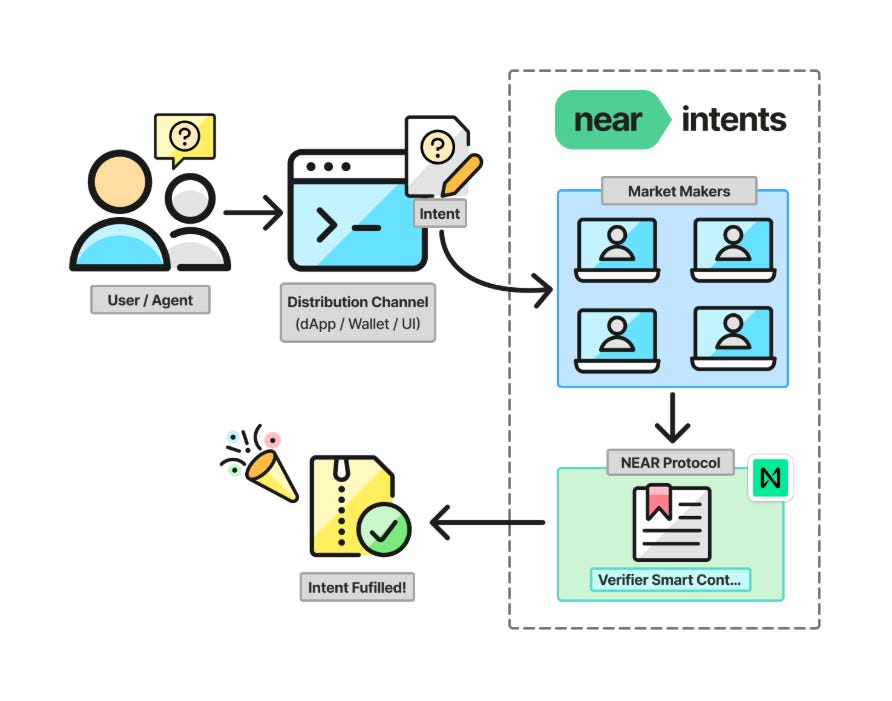
Another key piece of NEAR’s approach to AI is something called chain abstraction. In most blockchain environments, interacting across different networks can quickly become complicated. Users have to think about which chain they’re on, how to move assets between networks, and which standards or tools to use. It’s a fragmented experience that adds unnecessary complexity.
Chain abstraction removes that burden. Instead of dealing with multiple blockchains, users and applications can interact with assets and perform actions as if everything exists within a single, unified system. The underlying complexity is still there but it’s handled behind the scenes.
NEAR implements chain abstraction through products like NEAR Intents and Chain Signatures. Today, more than 35 major blockchain projects are already using or integrating parts of this stack. If you look at the top 50 by market cap, a large portion is either already connected or in the process of doing so. This allows users and AI agents to move assets across NEAR, Bitcoin, Ethereum, Solana, XRP, Cardano, Avalanche, and many other networks without dealing with the usual friction. No manual bridging, less exposure to errors, and fewer steps.
For the AI use case, this is especially relevant. Agents will not operate on a single chain. They will need to interact across multiple systems, execute transactions, and coordinate actions. Without abstraction, that process becomes complex and inefficient. NEAR’s approach simplifies that layer, which makes it more suitable for an environment where machines, not just humans, are interacting with the system.
Moreover, from a performance perspective, NEAR combines low fees and fast finality.
|Chain | Average Fees | Transaction Finality |
|-------------|------------------|----------------------|
| NEAR | <$0.01 | ~1–2s |
| Ethereum | ~$0.1–$20+ | ~12–15 min |
| Solana | <$0.001 | ~0.4s + ~13s |
| Avalanche | <$0.05 | ~1–2s |
| Cardano | ~$0.1 | ~2–5 min |
This matters for AI agents. They need fast execution and low cost to operate efficiently.
Why Decentralized AI Matters
Using AI today often comes down to a trade-off between convenience and control.
Centralized systems like ChatGPT, Gemini, or Claude are easy to use, but they rely on collecting and processing user data. That data can be used to improve models, but it also introduces risks. Data leaks, misuse, or lack of transparency are part of that trade-off.
Real-world examples highlight why this trade-off matters. In 2023, engineers at Samsung unintentionally uploaded sensitive internal code to ChatGPT, exposing proprietary information through a public AI system. While this was not a malicious act, it showed how easily confidential data can leave controlled environments when using centralized AI tools.
For everyday users, the risks may seem less obvious, but they follow the same pattern. Personal conversations, business ideas, or sensitive details shared with AI systems can be stored, processed, or used in ways that are not fully transparent.
Decentralized AI approaches this differently. The concept of “User-Owned AI” means that the user controls their data and interactions. Instead of relying on a centralized provider, the system ensures that inputs and outputs remain private and verifiable.
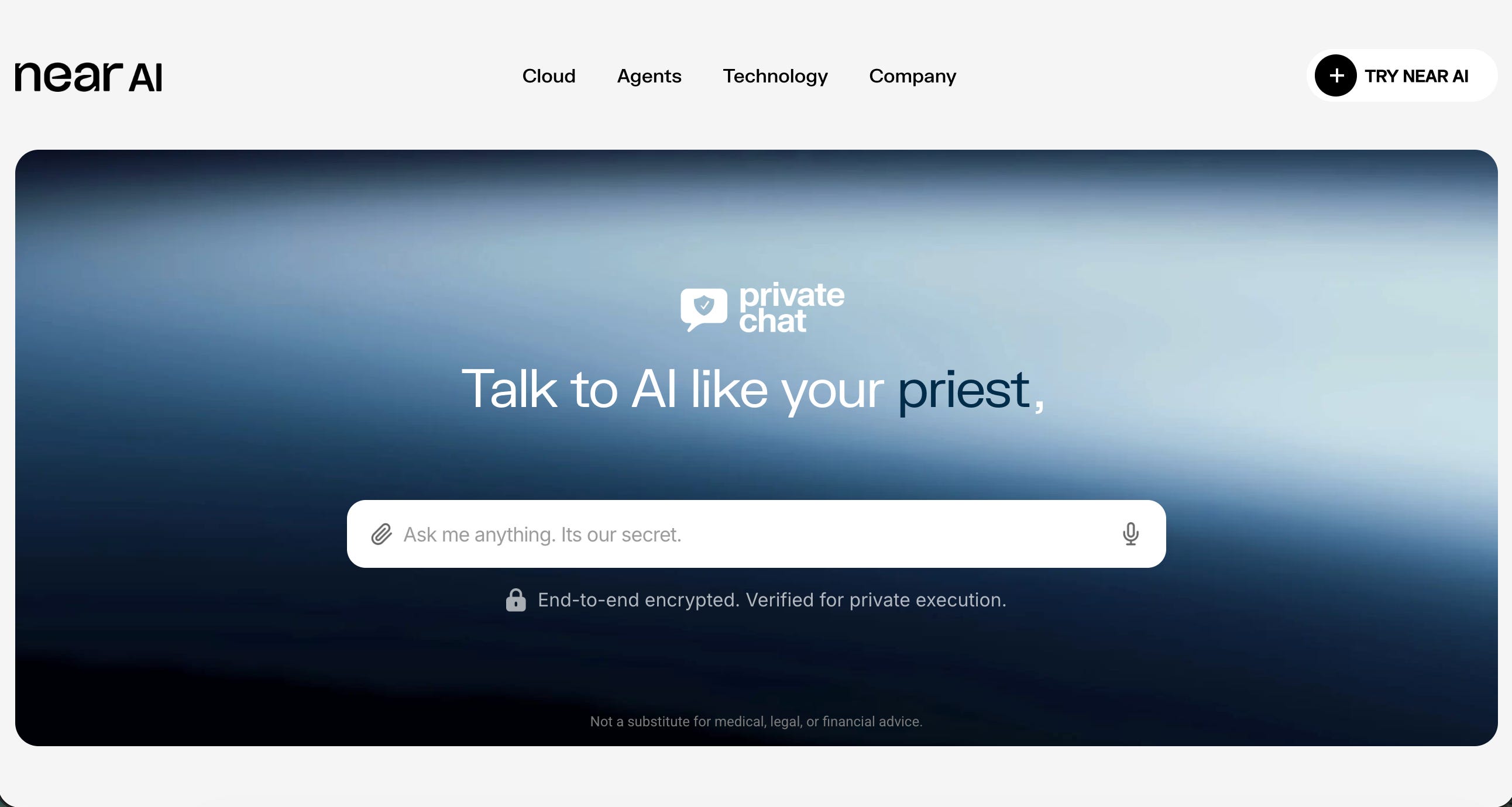
NEAR implements this through products like NEAR AI Cloud (as explained above) and Private Chat.
Private Chat works similarly to ChatGPT from a user perspective. You interact with an AI model through a simple interface. The difference is in what happens under the hood. You can choose which model you interact with, and your data remains protected through the infrastructure.
This reduces the risk of hidden manipulation or unintended data exposure.
For retail users, the difference may not seem critical at first. But as AI becomes more integrated into daily decisions, the question of who controls the data becomes more relevant.
The Current Ecosystem on NEAR
NEAR’s ecosystem already shows signs of real-world usage, which is often missing in early-stage narratives.
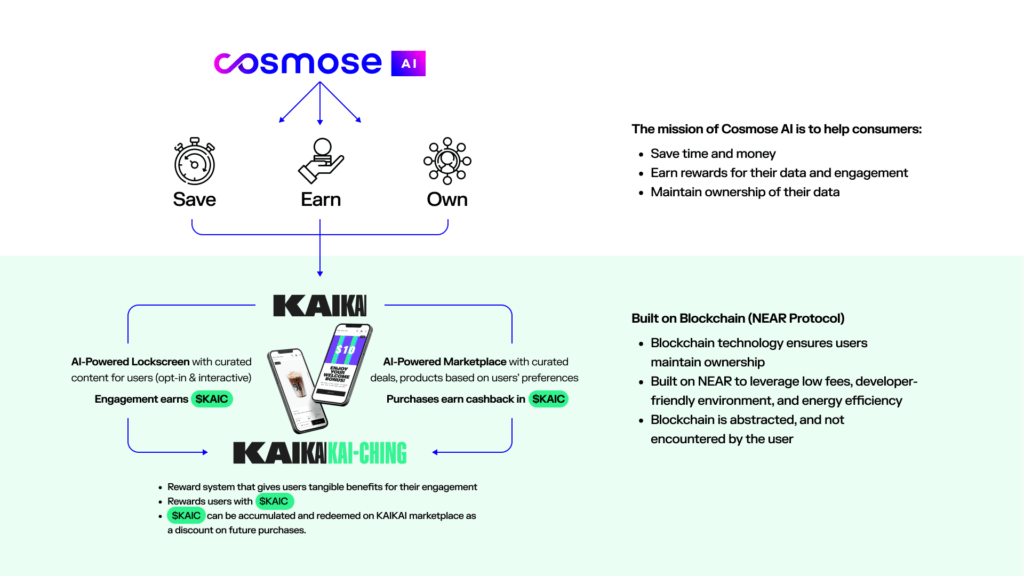
One of the most notable examples is Kai-Ching. It is part of the Cosmose AI ecosystem and functions as a reward-based currency within shopping applications like KaiKai. Users earn tokens through engagement, which can be used within the platform.
While it is not positioned as a crypto-native app, it runs on NEAR infrastructure and contributes to network activity. This has helped NEAR reach around 46 million monthly active users, placing it among the most used networks.
Another important component of its ecosystem is NEAR Intents, as explained above in the text. It has already generated significant volume, with billions processed and hundreds of thousands of active users.
Beyond that, the ecosystem includes wallets such as HOT and Meteor, DeFi platforms like Rhea Finance, and staking solutions like Meta Pool.
The common theme is usability. Many of these tools aim to reduce complexity for the end user.
AI Crypto Projects and How They Differ
NEAR is not the only project operating in the AI/crypto space. But the differences between them are often misunderstood.
Bittensor focuses on decentralized intelligence production. It creates a network where participants contribute computing power and models, forming a distributed system that generates AI outputs.
NEAR, on the other hand, focuses on infrastructure. It provides the environment where AI-powered applications can be built and used.
FET/ASI represents another layer. It focuses on autonomous agents that can perform tasks such as logistics, trading, or coordination between systems.
These approaches are not mutually exclusive. A simple way to understand the relationship is through roles. NEAR acts as infrastructure, Bittensor provides intelligence, and FET builds agents that use that intelligence. For example, an AI agent could use Bittensor to generate decisions, execute actions through NEAR, and operate as part of a broader system designed with FET tools.
Rather than competing directly, these systems can be combined.
NEAR Tokenomics and Value for Holders
NEAR’s tokenomics are structured to reduce long-term supply pressure.
In 2025, emissions were reduced from 5% to 2.5%, lowering inflation. At the same time, transaction fees are partially or fully burned.
All fees from native transactions are burned, and a large portion of smart contract fees are also removed from circulation. This introduces a deflationary component.
Additionally, part of the revenue from NEAR Intents is used to buy back NEAR tokens, further reducing supply.
For holders, staking provides another layer of participation. By staking NEAR, users contribute to network security and earn rewards, currently around 4.5% APY.
Vini runs a validator at thecoding.pool.near, where users can delegate their tokens. The process includes a short unbonding period, and rewards are compounded regularly.
Beyond staking, NEAR can be used in DeFi or governance, depending on the user’s strategy.
Closing Words
Special thanks to Vini for contributing to this article. 🍻
He has been active in the crypto space since 2020 and focuses on topics such as AI, privacy, and open-source systems. He also runs a NEAR validator and contributes directly to the ecosystem.
If you are interested in NEAR or AI-related developments in crypto, following his work is a good way to stay informed.
You can also delegate to his validator if you choose to participate in staking (thecoding.pool.near, with over Ⓝ210K staked delegations).
After going through this analysis, my conviction is gradually increasing that NEAR is a high-quality project with strong fundamentals behind it. I’ve started actively thinking about allocating to it once market conditions become more favorable for altcoins. As always, the focus of this newsletter is identifying those regime shifts. 💪
If you have any questions or topics you would like us to explore further, feel free to leave a comment under the post. Vini and I will use that feedback to improve and expand future updates on NEAR.
In the next posts from this series, I’ll also cover projects like Bittensor and the Artificial Superintelligence Alliance (ASI), to build a broader view of the AI–crypto space.
Thank you for reading.
This is not financial advice.
See you soon! 🍻