
How would you react if your crypto portfolio suddenly became much safer and easier to manage, but under a new set of rules and constraints?
That is precisely what the new U.S. crypto legislation promises (and may soon deliver). The focus is on so-called major crypto market structure legislation, specifically the CLARITY Act (Digital Asset Market Clarity Act), which has recently returned to the spotlight. Congressman French Hill, one of the key Republican figures on the House Financial Services Committee, has publicly stated that he expects President Trump to sign this major bill “very soon,” calling it “extremely important.” On X (Twitter), this topic is currently dominating discussions among crypto participants.
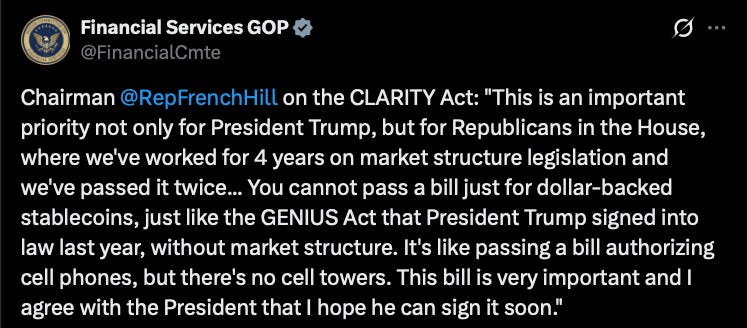
Put simply: crypto today operates in a gray zone. The SEC treats many tokens as securities subject to strict rules, while Bitcoin and Ethereum are more commonly viewed as “commodities,” falling under lighter oversight via the CFTC. This regulatory ambiguity has led to lawsuits, corporate hesitation, and institutional caution. If this legislation passes, most cryptocurrencies would move under a more lenient regulatory framework, stablecoins (such as USDT and USDC) would receive a formal safety structure, and chaos like FTX or LUNA would become harder to repeat. For retail investors, this could mean more institutional capital entering the market, easier access through banks and mainstream apps, but also new constraints, for example, fewer extreme yield opportunities in DeFi.
I wrote this post to explain what this new U.S. crypto legislation actually is, why it matters for your wallet, what its implications may be, what to expect from digital asset prices over the next 12 months, why Brian Armstrong (Coinbase CEO) currently does not support this version of the bill, and finally, my own view. If you are a retail participant who wants to stay ahead of the curve in terms of understanding, keep reading. This could turn out to be one of the biggest catalysts for 2026.
What Exactly Is This Legislation? (A Beginner-Friendly Explanation)
You are probably not a lawyer, and neither am I, so let’s break this down simply:
At the moment, the U.S. crypto market operates in a large regulatory gray zone. The SEC views most tokens as securities or investment contracts, which implies strict compliance, lawsuits, and extensive paperwork. This is why Coinbase, Ripple (XRP), and even some DeFi projects have faced legal action over the years. The result is that companies are reluctant to operate in the U.S., while retail investors are left uncertain: what if your favorite altcoin suddenly becomes “illegal,” or its mere possession puts you at legal risk?
This new legislation (primarily the CLARITY Act and related Senate bills) aims to change that in several key ways:
Regulatory split – Most “digital commodities” (such as Bitcoin, Ethereum, Solana and many other tokens) would fall under the supervision of the CFTC (Commodity Futures Trading Commission). The CFTC is generally more market-focused and less aggressive than the SEC, which could mean fewer lawsuits and more room for innovation.
Stablecoin framework – Stablecoins like USDC and USDT would receive a federal regulatory framework. This would require 1:1 reserves (actual dollars or equivalent Treasury assets), regular audits, and clear rules for failure scenarios. The result is increased safety (lower risk of depegging events), but potentially fewer extra rewards or yields currently offered by some platforms if interest rates need to be capped for compliance.
Stronger fraud protection – Enhanced measures against scams, pump-and-dump schemes, and fraudulent projects, directly protecting retail investors who often lose funds to rug pulls.
In short, the core elements are:
A regulatory split (SEC for security-like tokens, CFTC for others)
A stable and transparent framework for stablecoins (reserves + audits)
Anti-fraud and consumer protection measures
If you hold USDC in your wallet, this could mean sleeping more peacefully, but also potentially giving up some of the bonus yields you may be accustomed to on DeFi platforms.
Next, I look at how these changes could affect your portfolio.
Why Does This Matter for Retail Investors Like You?
For retail investors, this legislation is not distant politics. It directly affects your capital, your safety, and your opportunity set.
Potential positives (why this could be beneficial):
Less fear of sudden regulatory shocks: reduced risk that the SEC unexpectedly labels your favorite altcoin a “security” and effectively bans it in the U.S., leaving you with losses or legal uncertainty.
Easier access to crypto: banks and traditional apps (such as Robinhood or even your regular bank) would be more willing to integrate crypto services. Imagine buying BTC directly through your banking app without juggling KYC across multiple platforms.
Improved liquidity and potentially higher prices: clear rules enable institutions (funds, banks) to allocate capital. That means more buyers, higher trading volumes, and potentially stronger price moves, similar to what we saw with Bitcoin ETFs.
Potential downsides (real risks to be aware of):
Exchanges may increase fees or limit certain services to meet compliance requirements: platforms like Coinbase will face higher operational costs.
DeFi and yield farming may suffer: projects offering high stablecoin yields or tokenized assets could be restricted or prohibited in the U.S., reducing opportunities for extra income you may have relied on.
As someone who lost money in the LUNA collapse, I understand why this Act could help prevent the next major meltdown. In essence, it may make crypto a “safer” and more “legitimate” place for capital, potentially with greater long-term upside, but fewer short-term, highly speculative opportunities.
What Are the Implications for Your Investments?
We now move to what you are probably most interested in: how this legislation could affect your portfolio, not in theory, but in practice.
Short term (next 3–6 months):
High volatility around the news: if Trump signs the bill soon (as Hill expects), expect a pump. Bitcoin could easily jump 10–20%+ in the days following the announcement, with ETH and major altcoins following. We saw similar behavior around ETF approvals in 2024.
If the signing is delayed or the bill is weakened through unfavorable Senate amendments, a dip is possible: markets dislike uncertainty, and BTC could fall back toward $80K or lower on negative news.
In short: this is a classic “buy the rumor, sell the news” scenario, where more agile retail investors often enter ahead of the signing and exit at peak euphoria.
Medium term (6–12 months):
Large inflows of institutional capital: once the rules are clarified, pension funds, hedge funds, and banks can enter without regulatory fear. Estimates suggest this could bring trillions of dollars of new capital into the crypto ecosystem.
Improved safety = fewer scams and rug pulls: greater trust tends to support more stable growth, especially for BTC and ETH.
But fewer “wild” opportunities: DeFi yield farming, some meme coins, or higher-risk protocols may lose appeal as they become restricted or more costly to operate in the U.S.
Long term (1+ years):
The U.S. becomes the “crypto capital of the world” (Trump’s vision): this could push BTC to new ATHs ($200K+?), ETH toward $15K+, and total market cap toward $5–7 trillion.
Tokenization of real-world assets (real estate, equities, and bonds on-chain) becomes mainstream: a major opportunity for long-term holders.
However, constraints on innovation: if the bill disproportionately favors large players (banks, major exchanges), DeFi and smaller projects could suffer. Retail investors may lose one of their current advantages: access to high yields (10–50%+ on stablecoins), which could be reduced or banned in the name of “safety.”
The biggest risk for retail investors:
If the law ends up overprotecting TradFi (banks and large corporations), smaller players may be left with lower returns and less market freedom, precisely the concern Armstrong has raised. On the other hand, if the bill is improved and remains balanced, this could become the largest bullish catalyst for 2026–2027.
Overall: a net positive for most of us holding BTC / ETH / SOL (and stablecoins or tokenized gold), but with caution toward DeFi and smaller altcoins.
Why Is Brian Armstrong Against This?
Brian Armstrong, CEO of Coinbase, has not historically been opposed to crypto regulation. On the contrary, Coinbase has lobbied for regulatory clarity for years and previously supported bills such as FIT21. However, in January 2026 (specifically around January 14–15), Armstrong publicly withdrew support for the current draft of the CLARITY Act(and the related Senate Banking draft), stating that Coinbase “can’t support the bill as written” because it contains “too many issues.”
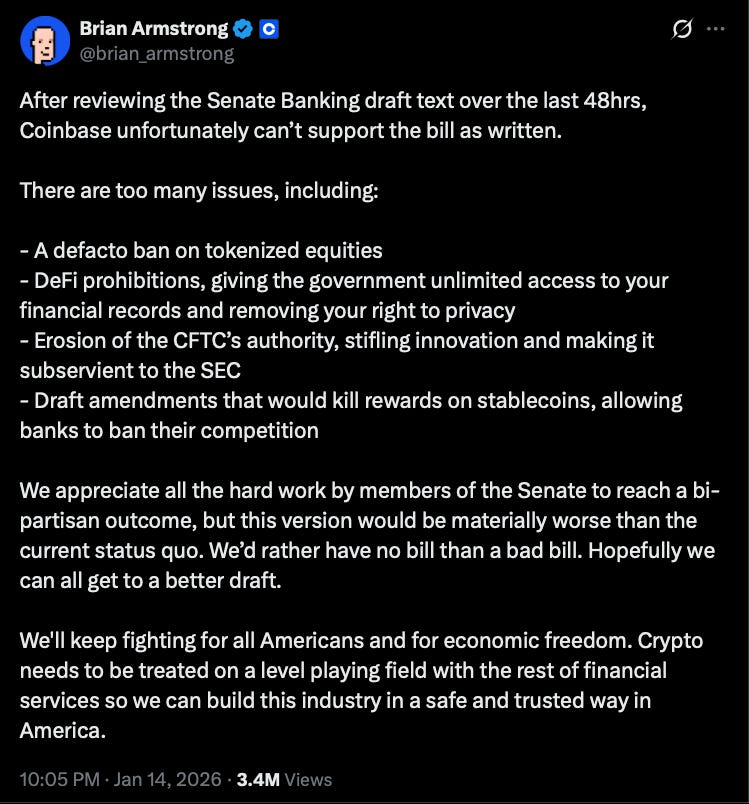
Here are the key reasons he cited (based on his X posts and interviews):
It overly favors the SEC: instead of strengthening the CFTC (the industry’s preferred regulator for most crypto), the bill erodes CFTC authority, potentially reintroducing stricter rules and more enforcement actions.
Restrictions on stablecoin rewards and yield: the draft would ban or severely limit interest or rewards on stablecoins (such as those offered by Coinbase). Armstrong views this as an attempt by banks to protect their business models and limit competition from firms like Coinbase.
Limits on tokenized assets and commingling: restrictions on tokenization of real-world assets (e.g., equities on-chain) and bans on commingling of funds, which could slow innovation in DeFi and tokenization.
Overall risk of “killing” innovation: rather than supporting crypto growth, the bill could favor large TradFi players (banks) while constraining decentralized alternatives.
It is important to note that stablecoins account for a meaningful portion of Coinbase’s revenue (around 20% in Q3 2025). If you use Coinbase, this could translate into higher fees, fewer stablecoin yield options, or restricted access to certain DeFi features in the U.S.
That said, Armstrong is pushing for a better version of the bill; he has stated that he would prefer “no bill than a bad bill” and sees a path forward if the draft is improved. The White House reportedly opposed his move (which contributed to delaying the Senate markup), but he remains optimistic that the outcome can still favor the industry.
Closing Words
As a retail investor who has lived through several bull and bear cycles, here is my honest view on the CLARITY Act and crypto regulation more broadly:
Without a meaningful regulatory framework, even an imperfect one, the crypto industry will not grow at the pace many of us would like. Institutions, pension funds, and traditional banks will not deploy trillions of dollars until they see clear rules and reduced legal risk. That implies slower price appreciation, less liquidity, and fewer large opportunities for smaller players.
At the same time, crypto is a powerful technology capable of addressing real problems in the financial system, from excessive banking fees and slow cross-border payments to centralized control over money. For that potential to materialize, it needs freedom: freedom to innovate, for DeFi protocols to experiment with new models, for stablecoins to offer competitive yields, and for real-world assets to be tokenized without every idea being suffocated by compliance requirements. If the bill tilts too far in favor of TradFi (banks and large exchanges) and undermines that freedom, there is a real risk that crypto becomes “just another regulated financial product” rather than a genuine alternative.
That is why I see this as a net positive, but only if Armstrong and the broader industry succeed in pushing for a better version of the law. If that happens, 2026 and 2027 could be years of meaningful growth, particularly for BTC and other high-quality projects.
I’d be interested to hear what you think: is more regulation good or bad for crypto in the long run? Would you prefer a “safer” but slower-growing market, or more freedom with higher risk?
Thanks for reading all the way through. If you like this content, consider subscribing to the newsletter. In upcoming posts, I’ll share:
Whether the market is currently predominantly risk-on or risk-off,
Which assets I hold across those regimes,
How my portfolio is performing in real time since my first post here.
See you in the next post, and may your wallet stay green. 🍻