👋 Welcome back.
Today we are looking at the latest update in Global Liquidity (GLI) and U.S. liquidity, and what these signals might mean for the crypto market. Liquidity conditions are slowly improving, but the pace remains modest. At the same time, several macro indicators still point to a cautious environment rather than a full risk-on regime.
The current setup sits somewhere between two outcomes. On one side, the data suggests a stable economy that may be approaching the early stages of a growth phase. On the other hand, inflation remains stubborn and geopolitical risks have increased, which keeps the probability of financial stress on the table.
The goal of this weekly article is simple: understand where financial markets are heading and which crypto assets make the most sense to hold under current conditions.
📬 In this issue:
Global Liquidity and U.S. Liquidity - Update
Key macro signals shaping financial conditions
Crypto market positioning and sentiment
My Portfolio Setup
Before we dive in, one small favor. If you find this analysis useful, consider hitting the ❤️ button or sharing the post. It helps this newsletter reach other retail investors trying to navigate the same environment.
As a fellow retail investor, I’ve been tracking these indicators closely. Let’s break the data down.
GLI and US Liquidity Breakdown
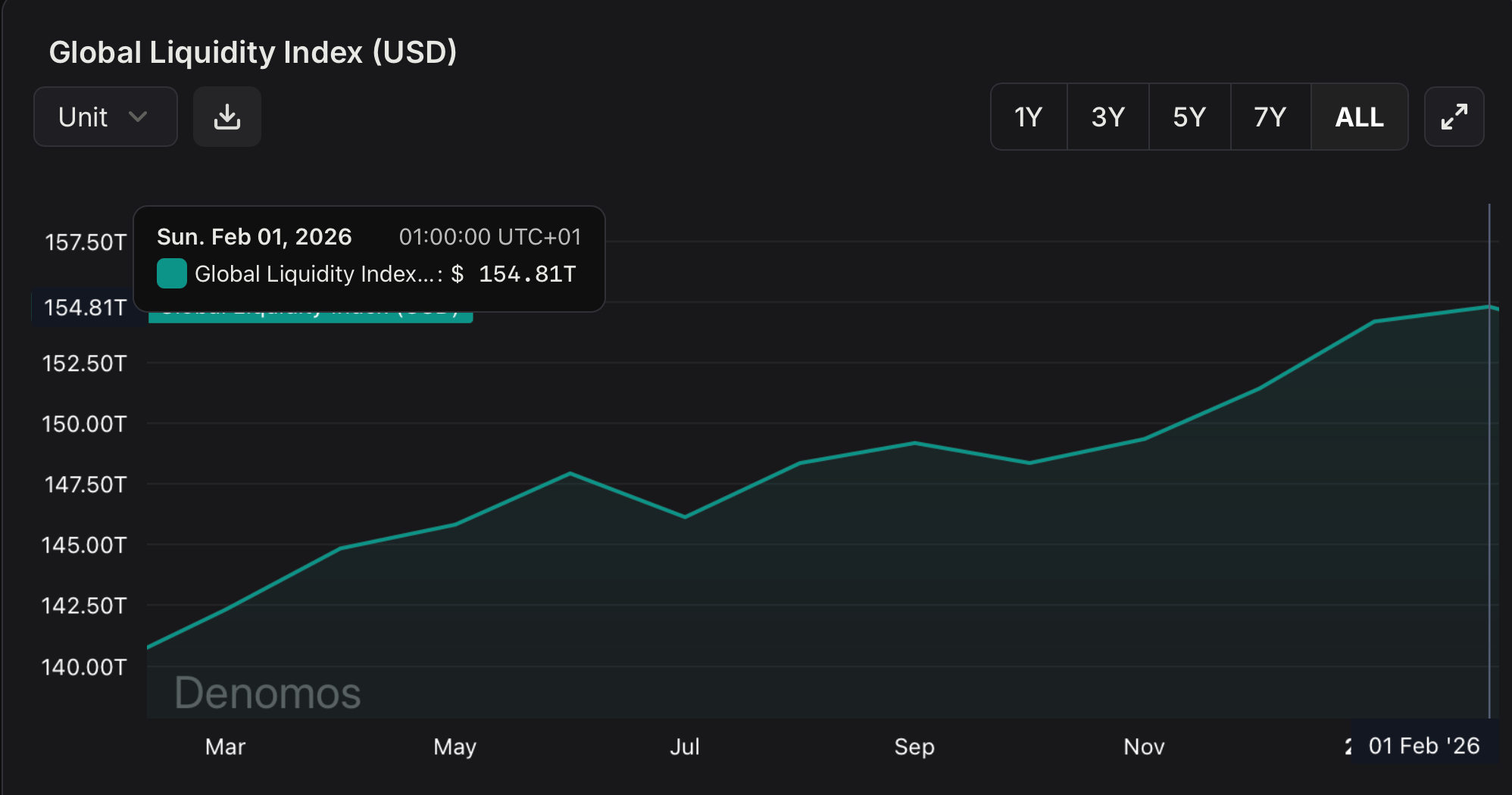
The latest Global Liquidity Index (GLI) update shows continued growth, but the pace remains relatively slow compared with periods that typically support strong risk-on environments.
In February 2026, GLI reached $154.81T, up from $152.66T in January. That represents $2.15T month-over-month growth, roughly 1.5%. Over the last four months, global liquidity expanded by about $6.5T.
On the surface, the direction is positive. Liquidity is expanding rather than contracting. However, the magnitude still falls short of what is usually required to push speculative assets into a strong uptrend.
Historically, sustained risk-on conditions tend to appear when liquidity grows 2% or more per month for several consecutive months, particularly when the expansion is led by the United States. That is not yet the case.
The year-over-year growth rate for GLI currently sits around 10.5%, but an interesting shift appeared this month. Since September 2025, the YoY chart showed consistent acceleration each month. February breaks that pattern, with YoY growth slightly weaker than the previous month. Momentum is still positive, but the trend is no longer strengthening.
The picture becomes even more cautious when looking at U.S. liquidity.
In February 2026, U.S. liquidity stands at $28.21T, only marginally above $28.16T in January. More importantly, it remains below the September 2025 level of $28.26T.
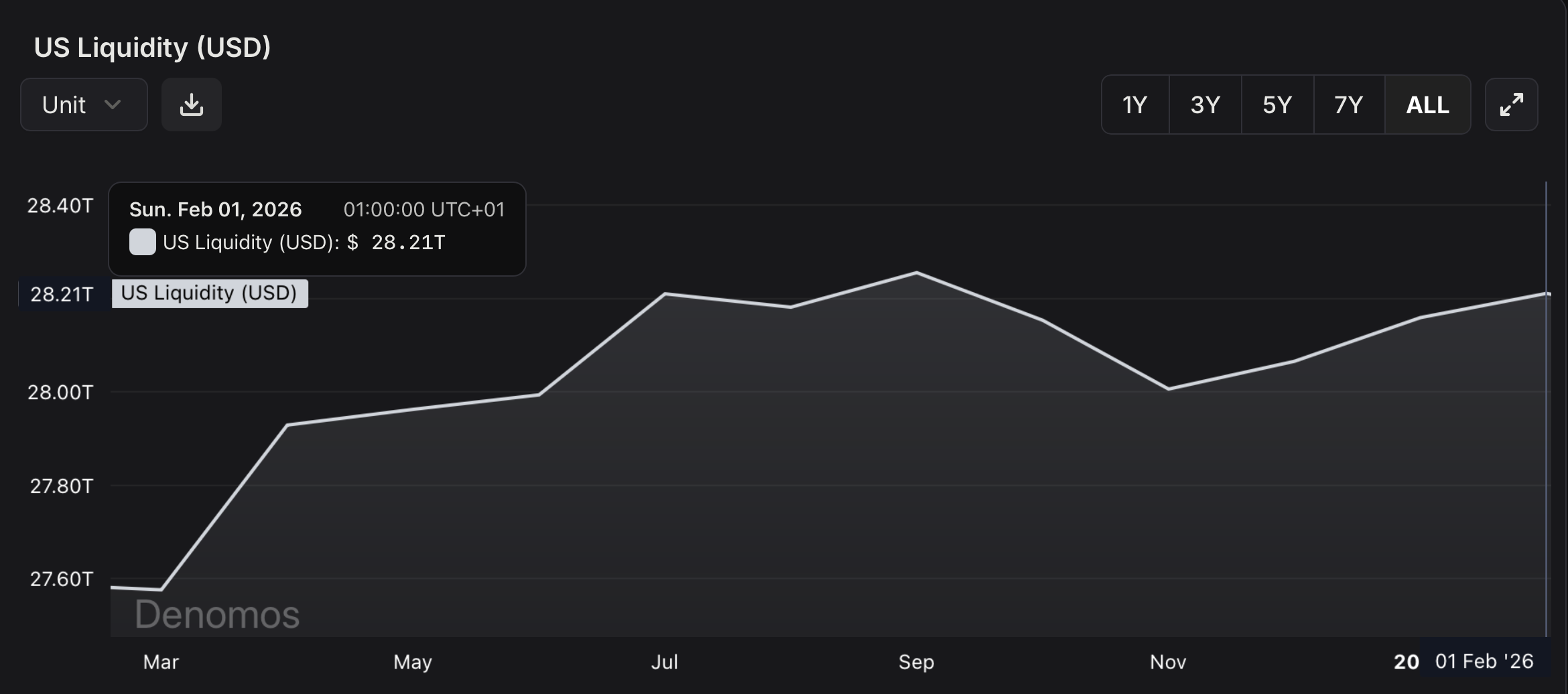
That matters because U.S. liquidity historically plays the dominant role in crypto market cycles. During the early phase of the previous altcoin cycle in 2020, U.S. liquidity expanded by roughly 25% in just three months. Compared with that environment, current growth looks close to stagnant.
The YoY growth rate of U.S. liquidity is only 2.26%, which is relatively weak. In previous risk-on phases, similar growth often occurred within a single month rather than an entire year.
Taken together, global liquidity is improving but still modest, while U.S. liquidity remains largely flat. That combination usually translates into a market that stabilizes, but not one that immediately launches a broad altcoin cycle.
Beyond the GLI: Other Market Signals Showing Tight vs. Eased Conditions
Liquidity rarely acts alone. To understand the broader environment, it helps to look at several additional macro indicators.
The U.S. unemployment rate rose slightly to 4.4% in February, compared with 4.3% the previous month. The change is small and does not yet indicate meaningful labor market deterioration. For now, it remains largely neutral.
Inflation remains the more relevant variable. CPI currently sits at 2.4% from the January release, while the PCE inflation measure recently moved to around 3%. With the next CPI update scheduled for March 11, a modest increase toward roughly 2.6% would not be surprising. If that happens, it would reinforce the idea that inflation is proving somewhat sticky.
Interest rate conditions reflect that tension. The Federal Reserve policy rate is currently around 3.64%, and expectations for the upcoming FOMC meeting suggest no immediate changes.
Because inflation has not yet returned fully to target, the real interest rate (RIR) remains positive at roughly +0.65%. Positive real rates generally tighten financial conditions and tend to slow the shift toward speculative assets.
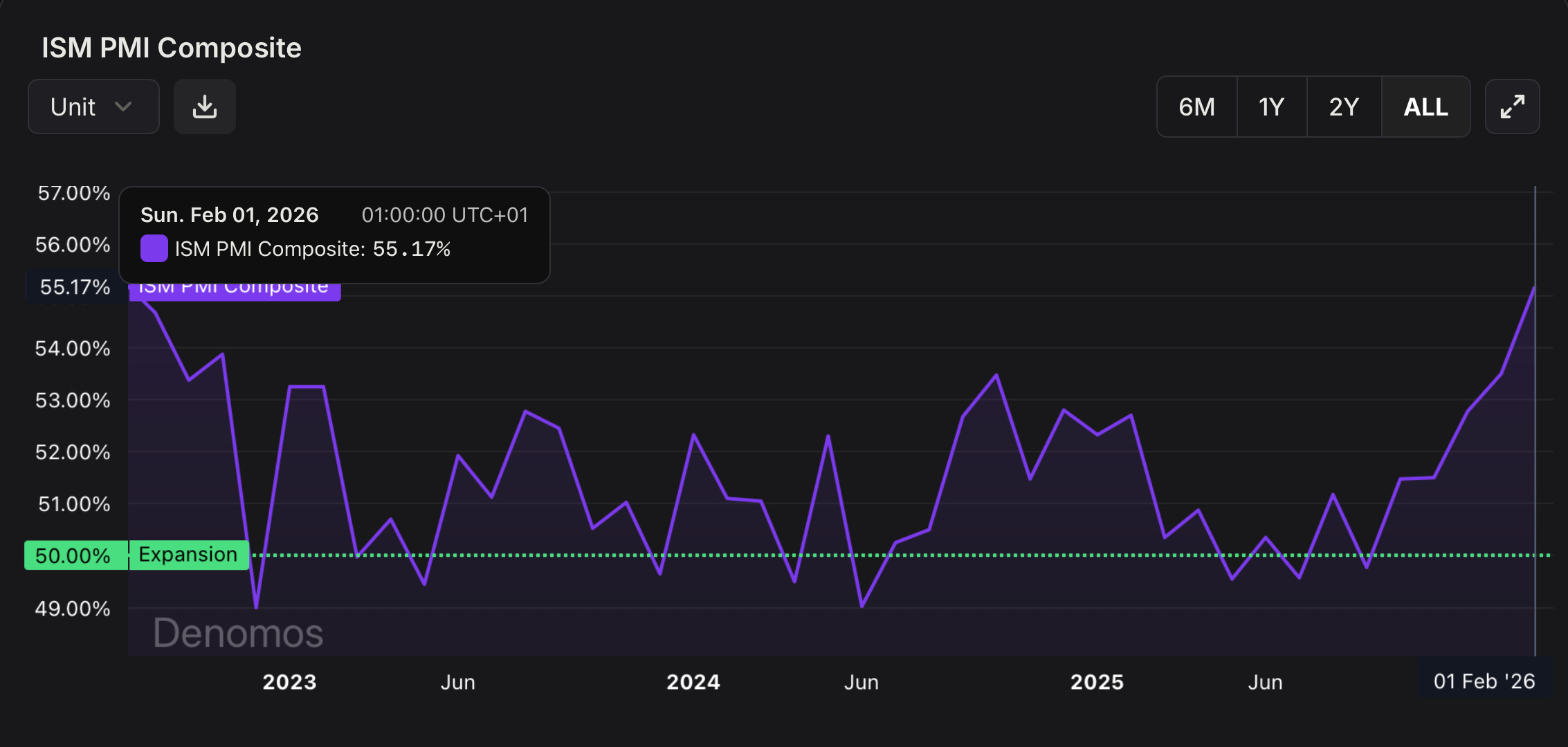
Economic activity indicators, however, show improvement. The ISM PMI Composite index reached 55.2 in February, increasing by 1.7 points month-over-month. Much of this strength came from the services sector. Values at this level have not been seen since mid-2022, and the index has been trending upward for several months. That pattern usually appears during the early stages of economic expansion.
Market pricing of risk also provides signals. TIPS yields remain around 1.8%, which indicates investors still find real yields attractive. When real yields stay high, the incentive to move aggressively into risk assets tends to remain limited.
Currency markets reflect similar uncertainty. The U.S. Dollar Index (DXY) continues to trade within a consolidation range between 96 and 100, suggesting that investors do not yet have a clear directional view.
Commodity markets show a different dynamic. Gold remains in a strong bull trend around $5200 per ounce, a pattern often associated with cautious capital allocation. Meanwhile, WTI oil prices have surged roughly 90% since December, largely due to geopolitical tensions in the Middle East. If that rise proves temporary, its macro impact could remain contained. If it persists, inflation pressures could increase.
Credit markets currently show little stress. High-yield spreads remain stable near 3%, which suggests limited fear in corporate credit markets. At the same time, the yield curve spread has been gradually rising since mid-2023, a configuration that often appears ahead of economic expansion phases.
Taken together, these signals point to an economy that looks stable and potentially entering a growth phase, though still constrained by relatively tight financial conditions.
Crypto Market Stats
Crypto market positioning has also started to stabilize after a difficult period.
Sentiment remains weak but is gradually improving. The Fear & Greed Index currently sits at 19, up from 9 last month. While this indicator is far from precise, the change suggests that the extreme pessimism seen recently has started to ease.
Derivatives positioning remains relatively healthy. Bitcoin open interest is currently around 3.5% of its market capitalization, which indicates that leverage across the system is not excessive. Markets tend to behave more predictably when leverage remains moderate.
Another encouraging signal is coming from institutional flows. Bitcoin ETF outflows appear to have slowed significantly, suggesting that the forced selling phase may already be behind us.
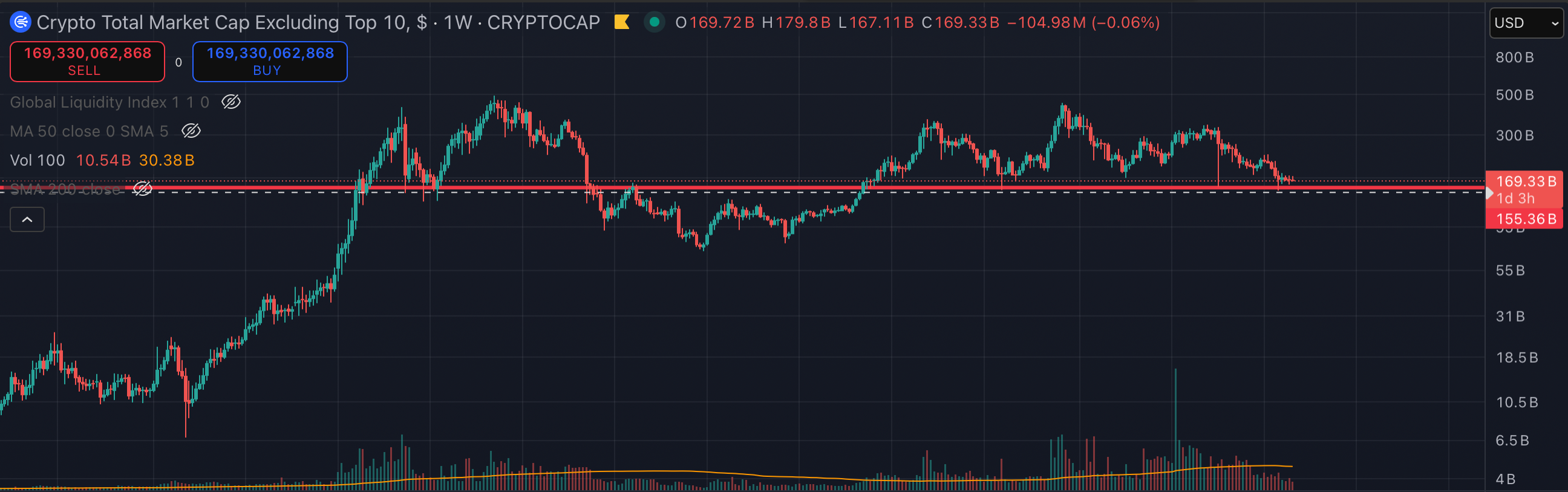
From a technical perspective, the total crypto market capitalization recently entered deeply oversold territory and has begun recovering. Traders are watching for a potential RSI divergence, which could indicate that selling pressure is gradually fading.
A similar pattern appears in the crypto market excluding the top 10 assets. That segment currently holds a strong support zone around $155B MCap, which has proven resilient so far. Let’s hope that a decisive break below that level doesn’t happen (otherwise we could see another 30%+ drop).
What This Means to My Crypto Portfolio
When looking at the full picture, the macro environment currently sits between two regimes.
On one side, most indicators suggest that the economy remains stable and may be approaching the early stage of a growth phase. The ISM PMI trend supports that interpretation, and credit markets show little sign of systemic stress.
On the other side, inflation remains slightly above target, and real interest rates are still positive, which keeps financial conditions relatively tight. At the same time, geopolitical risks have increased. The war in the Middle East and the sharp rise in oil prices introduce uncertainty that could quickly change the macro outlook.
Crypto markets appear to have absorbed much of the recent downside. Leverage is moderate, sentiment has been extremely weak, and altcoins are already trading near long-term lows.
For my own portfolio, that combination leads to a cautious positioning.
I currently remain 100% allocated to Bitcoin. The reasoning is simple. If markets gradually move toward a risk-on phase, Bitcoin usually benefits first. At the same time, it tends to carry less downside risk than most altcoins during uncertain macro conditions.
If financial conditions deteriorate significantly, I would likely consider shifting part of the portfolio toward tokenized gold as a defensive asset.
For now, I remain cautiously optimistic. Crypto markets have already endured several difficult years, and from current levels the asymmetry increasingly favors upside over downside, assuming no systemic crisis emerges.
But the key question remains:
Let me know your view in the comments and explain your reasoning.
Closing Words
If you’re new here, a quick introduction.
I’m a retail investor, just like many of the readers of this newsletter. I’m also the co-founder of Denomos, an analytics platform designed specifically for crypto retail investors.
All of the data discussed in this article is available on Denomos. The goal is simple: help investors understand market regimes and identify opportunities using macro and on-chain indicators.
One of the core tools on the platform is a simplified but comprehensive Global Liquidity Index. It combines central bank balance sheets, M2 money supply, Treasury General Account dynamics, the Reverse Repo Facility, and liquidity conditions across the 20 largest global economies.
The index is updated weekly and includes both cumulative liquidity levels and year-over-year changes. This makes it easier to track shifts in liquidity momentum across the global financial system.
The methodology is intentionally simpler than institutional products such as CrossBorder Capital, but still captures the main forces driving liquidity. At the same time, it provides far more context than most generic indicators commonly used on platforms like TradingView.
If you want weekly analytical posts like this, focused on understanding market regimes and positioning in crypto accordingly, consider subscribing to this Substack. 👇
The goal is not prediction. It is understanding the environment and adapting to it.
Thanks for reading. As always, this is not financial advice. It’s simply my interpretation of the data. Do your own research and manage risk carefully.